
Eligibility Requirements, Tax Benefits, Investment Obligations and the Application Procedure under Article 5A of the Greek Income Tax Code

In recent years, Greece has introduced a series of tax incentives aimed at attracting individuals, investors and capital from abroad.
One of the most significant is the special alternative taxation regime established under Article 5A of the Greek Income Tax Code (Law 4172/2013), widely known as the “Non-Dom” regime.
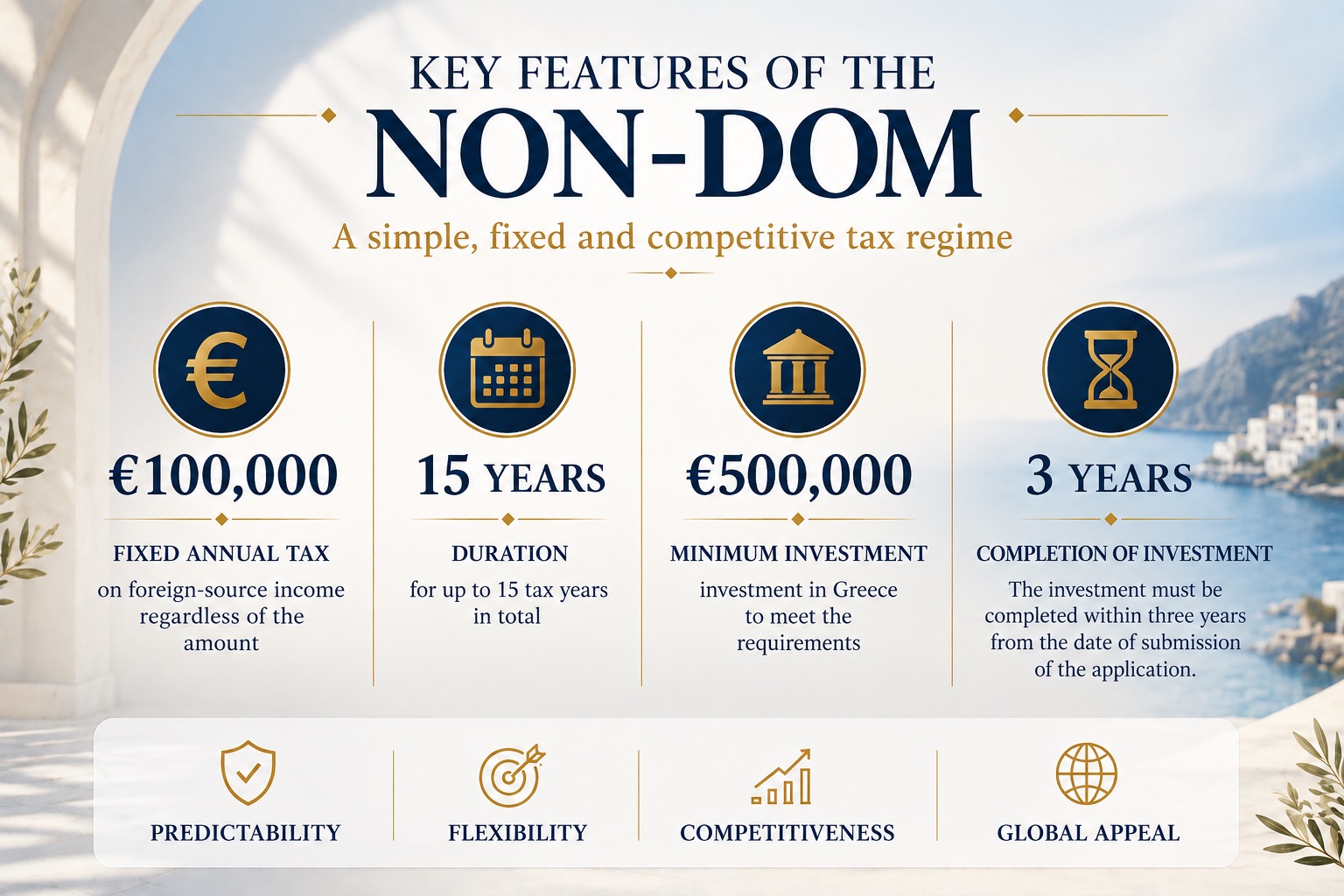
The Greek Non-Dom regime is designed for individuals who transfer their tax residency to Greece and satisfy specific eligibility requirements. Its principal advantage is that, instead of being taxed in Greece on their foreign-source income under the ordinary tax rules, qualifying individuals pay a fixed annual tax of €100,000, regardless of the total amount of income they earn abroad.
The regime may apply for up to 15 tax years, creating a particularly attractive framework for international investors, entrepreneurs and high-net-worth individuals considering transferring their tax residency to Greece.
Generally, an individual who is a Greek tax resident is subject to taxation in Greece on their worldwide income, meaning income derived both from sources within Greece and from abroad.
The Non-Dom regime introduces an alternative method of taxation for foreign-source income.
An individual transfers their tax residency to Greece but, provided their application under Article 5A of the Greek Income Tax Code is approved, pays a lump-sum tax of €100,000 per tax year on their total foreign-source income, irrespective of the actual amount of that income.
Payment of this amount fully discharges the individual’s Greek income tax liability in respect of foreign-source income covered by the special regime.
The Greek Non-Dom regime may be particularly attractive to:
However, meeting the formal eligibility requirements does not necessarily mean that participation in the Non-Dom regime will be financially advantageous in every case.
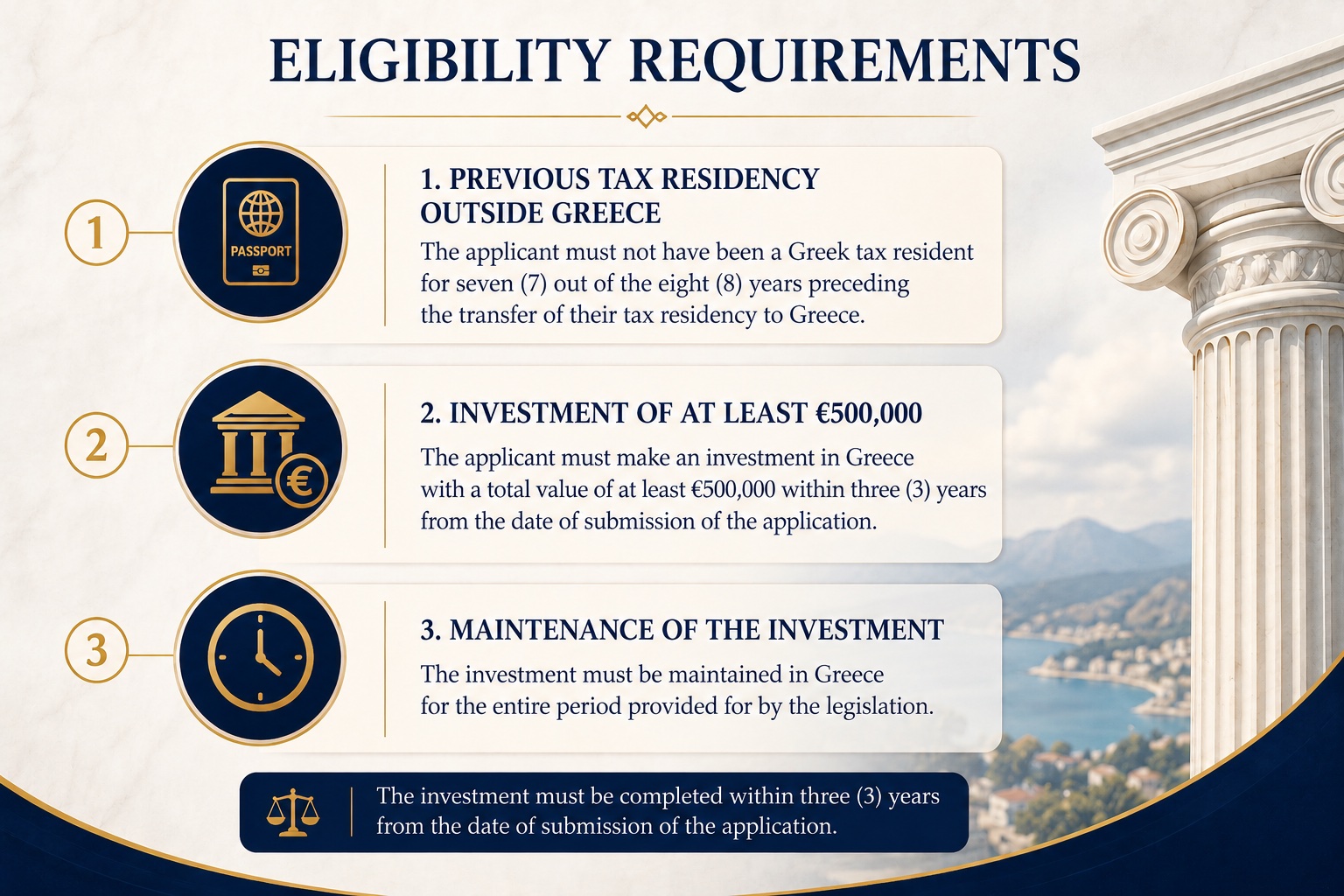
Two principal requirements must be satisfied cumulatively to qualify for the Greek Non-Dom regime.
1. Previous Tax Residency Outside Greece
The applicant must not have been a Greek tax resident for seven of the eight years preceding the transfer of their tax residency to Greece.
2. Investment of at Least €500,000 in Greece
The applicant must demonstrate that an investment with a total value of at least €500,000 is being made in Greece.
The investment may be undertaken by:
⚖ Legal Note
The investment must be completed within three years from the date of submission of the application for admission to the regime.
Greek legislation provides for different categories of investments that may qualify an applicant for the Non-Dom regime.
These include investments in:
In the case of real estate investments, the applicable regulatory framework provides, among other options, for the acquisition of property in Greece, such as buildings, building plots or parcels of land, as well as the construction of real estate, subject to the prescribed conditions.
The investment used to qualify for the regime must be maintained in Greece in accordance with the conditions and for the period stipulated by the relevant legislation.
For this reason, both the selection and structuring of the investment should be carefully assessed before it is undertaken.
The Greek Non-Dom regime offers a combination of tax predictability and flexibility for individuals with substantial international financial activities.
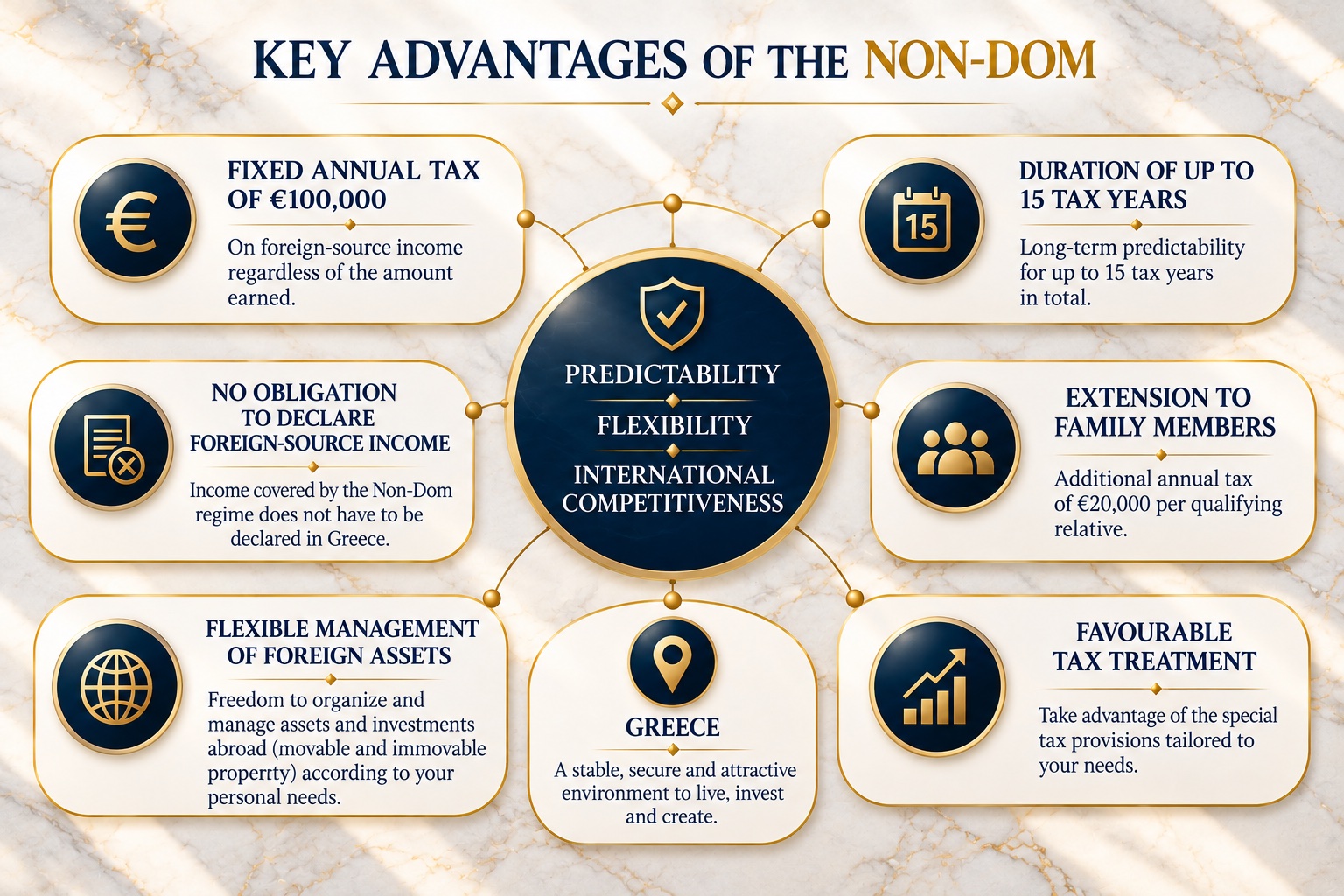
Its principal advantages include:
Yes. The requirement to make an investment of €500,000 does not apply in the specific case of an individual who has obtained and continues to hold the residence permit for investment activity in Greece prescribed by the relevant legislation.
This is a specific statutory exemption and should not be confused with investor residence permits generally.
Its applicability must be assessed by reference to the particular category of residence permit held by the individual concerned.
The principal advantage of the Non-Dom regime is the predictability of the taxpayer’s annual tax liability.
The taxpayer pays €100,000 per tax year in respect of foreign-source income, regardless of the total amount earned. Consequently, the lump-sum tax does not increase as foreign-source income increases.
For example, provided all the requirements of Article 5A are satisfied, whether an individual’s total foreign-source income amounts to €500,000 or €5,000,000, the annual lump-sum tax remains €100,000.
This is one of the main reasons why the regime is particularly attractive to individuals with substantial income and assets abroad.
The special regime applies to income arising from sources outside Greece.
Depending on the particular circumstances and the tax classification of each type of income, it may cover various categories of foreign-source income, including:
⚖ Legal Note
Particular attention must be paid to determining the country of source of each item of income.
The mere fact that an amount is paid from a foreign bank account or through a foreign company does not, in itself, mean that it constitutes foreign-source income for the purposes of Greek tax law.
The appropriate classification must therefore be assessed on a case-by-case basis.
The Non-Dom regime does not exempt the taxpayer from taxation on income arising in Greece.
Greek-source income must continue to be declared and taxed in accordance with the general provisions of Greek tax legislation.
A clear distinction must therefore be made between:
For example, rental income derived from a property located in Greece is not covered by the €100,000 lump-sum tax and is taxed in accordance with the general tax rules.
An important feature of the Non-Dom regime is that foreign-source income subject to alternative taxation under Article 5A does not have to be declared in Greece.
By contrast, any taxable income arising in Greece must be reported in the taxpayer’s Greek income tax return in the ordinary manner.
The €100,000 lump-sum tax operates independently. Any tax paid abroad on income covered by the alternative taxation regime cannot be credited against tax liabilities in Greece.
Similarly, the annual Non-Dom tax cannot be offset against other tax liabilities or any credit balances held by the taxpayer, nor can it be paid under an instalment payment arrangement.
This is an important consideration when undertaking tax planning before transferring tax residency to Greece.
Participation in the special regime may last for a maximum of 15 tax years in total.
Upon completion of the prescribed period, participation in the regime terminates and cannot be extended beyond the 15-year limit.
Yes. The taxpayer may request that the regime be extended to qualifying relatives. For the purposes of Article 5A, qualifying relatives include the taxpayer’s spouse and direct-line ascendants or descendants. Individuals who have entered into a civil partnership are treated in the same manner as married individuals.
For each qualifying relative whose inclusion is requested and approved, an additional lump-sum tax of €20,000 per tax year is payable.
The extension may be requested either at the time of the initial application or at a later date. Where the extension is requested subsequently, it applies only for the tax years remaining until the original applicant reaches the end of their 15-year period.
What Applies to Minor Children?
Unmarried minor children who live with the taxpayer are presumed to share the same tax residency. For this reason alone, no separate application to extend the regime or payment of the additional €20,000 tax is required.
However, if the children receive foreign-source income of their own and the intention is for that income also to benefit from the special tax treatment, the specific procedure prescribed by law must be examined.
The Greek Non-Dom regime also includes significant provisions concerning inheritance and gift taxation.
Upon payment of the lump-sum tax, an individual admitted to the regime is exempt from Greek inheritance or gift tax on movable property located abroad that they acquire through inheritance or gift.
Furthermore, an exemption from Greek inheritance or gift tax is provided for movable property belonging to the individual admitted to the regime, located abroad, and transferred to a third party upon death or by way of gift.
This treatment may be particularly significant for individuals holding substantial movable assets internationally, especially in the context of long-term wealth management and estate or succession planning.
However, this does not constitute a general exemption from all inheritance or gift taxes. The special provision applies specifically to the categories of movable property located abroad covered by Article 5A.
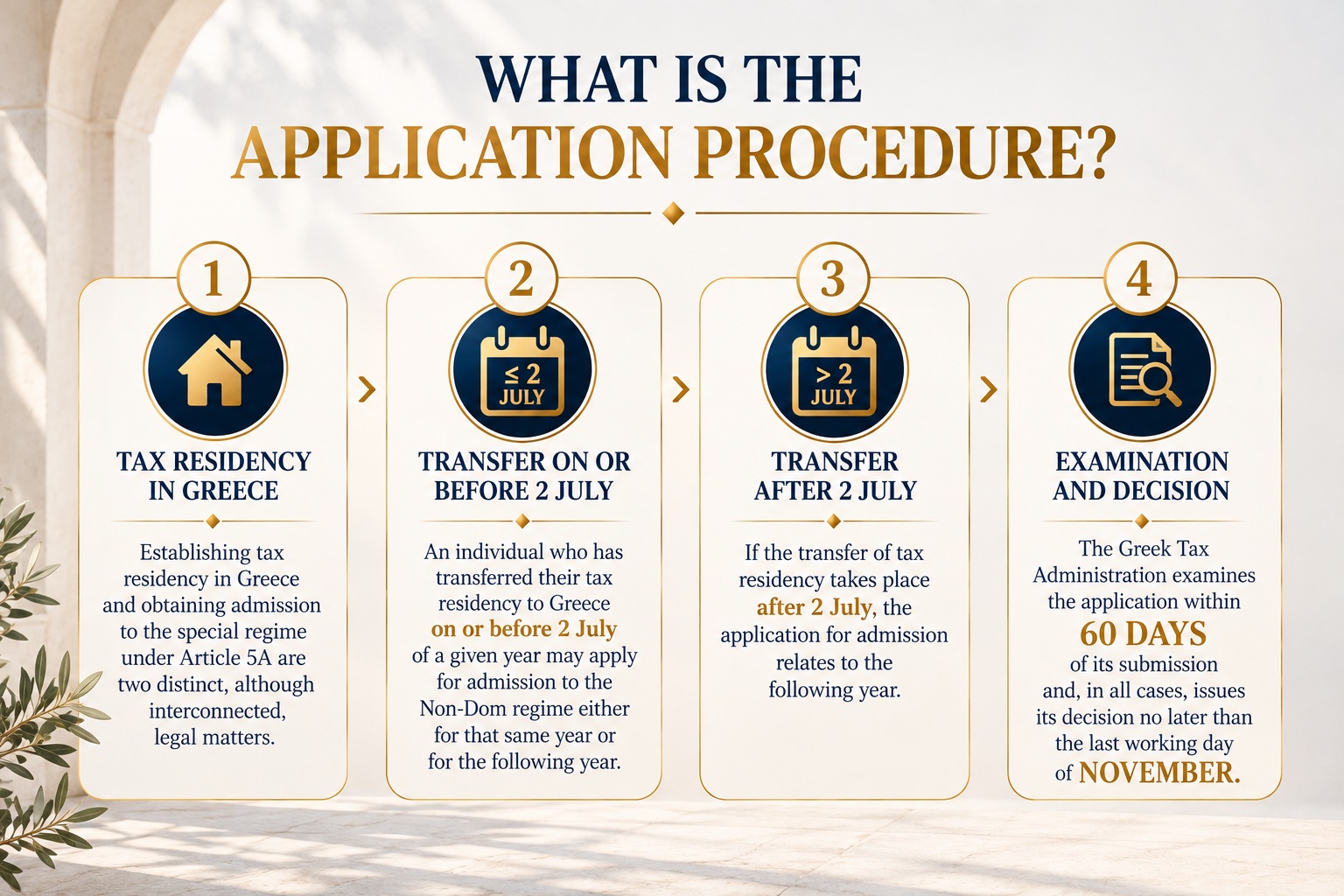
Establishing tax residency in Greece and obtaining admission to the special regime under Article 5A are two distinct, although interconnected, legal matters.
Under the procedure applicable from 2026, an individual who has transferred their tax residency to Greece on or before 2 July of a given year may apply for admission to the Non-Dom regime either for that same year or for the following year.
If the transfer of tax residency takes place after 2 July, the application for admission relates to the following year.
The Greek Tax Administration examines the application within 60 days of its submission and, in all cases, issues its decision no later than the last working day of November.
The lump-sum tax is payable each tax year in a single payment, no later than the last working day of December. Full and timely payment is particularly important for maintaining participation in the regime.
If the full prescribed amount is not paid in a particular tax year, the individual ceases to qualify for the Non-Dom regime from that tax year onwards and becomes subject to taxation on their worldwide income under the general provisions of Greek tax law.
Completion of the required investment within the prescribed three-year period is an essential condition of the regime.
If, following the expiry of that three-year period, it is established that the investment has not been completed in accordance with the law, admission to the regime under Article 5A is revoked retroactively from the year of initial admission. The taxpayer then becomes subject to the general rules governing taxation of worldwide income, together with any further tax consequences prescribed by law.
For this reason, the selection, implementation and documentation of the investment should be carefully planned from the very beginning of the process.
Yes. The Non-Dom regime does not require the taxpayer to remain enrolled for the entire 15-year period. The taxpayer may request the revocation of their admission to the regime. Under the applicable procedure, an application for revocation must be submitted by 30 September of the tax year for which the revocation is requested.
From that tax year onwards, the general taxation rules apply.
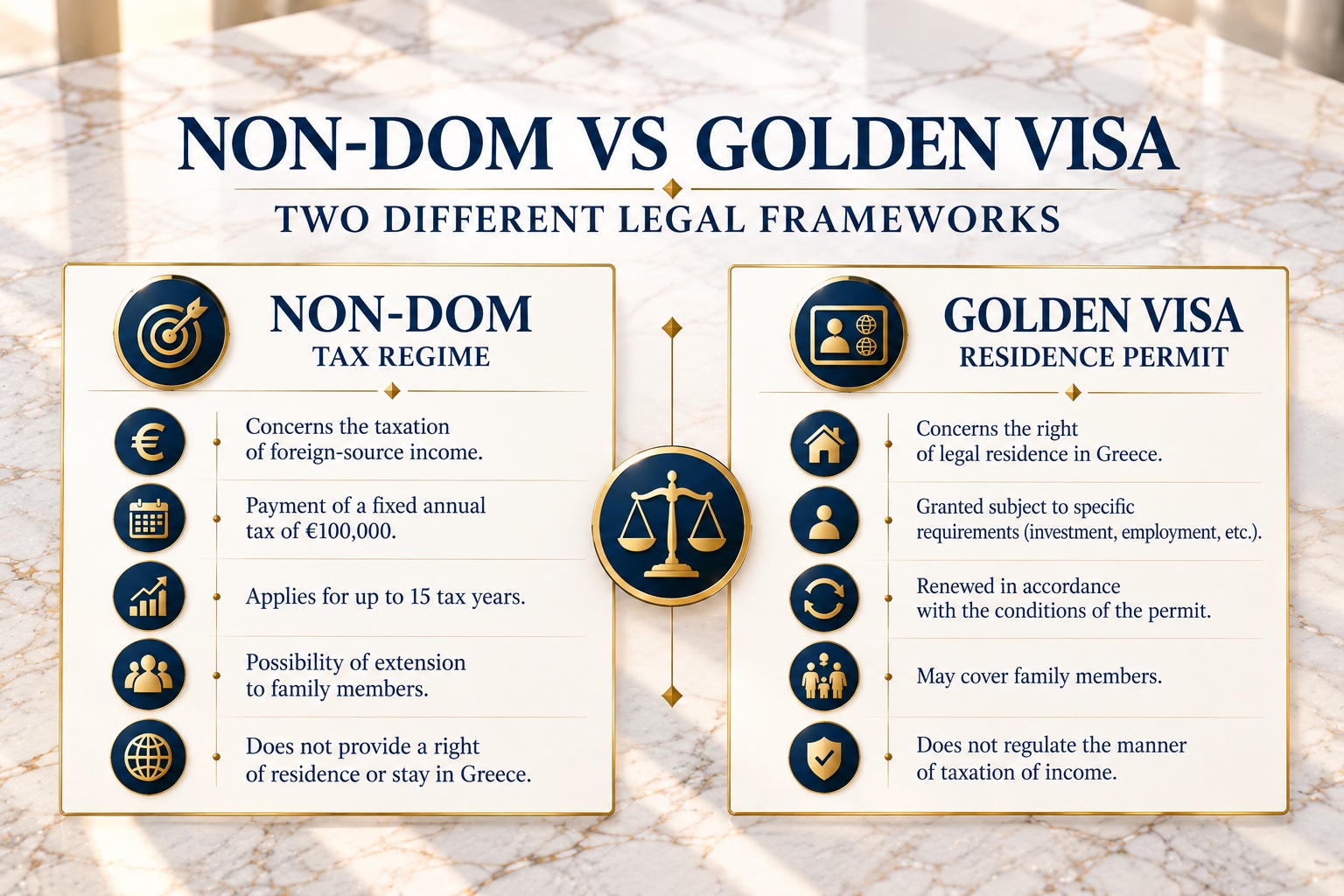
No. Non-Dom is a tax regime, not a residence permit. It does not, in itself, grant an automatic right to enter, reside or work in Greece.
Tax residency, admission to the special regime under Article 5A and the right to lawful residence are separate legal matters.
Consequently, third-country nationals wishing to establish themselves in Greece must also consider the appropriate immigration arrangements that would allow them to reside legally in the country.
Likewise, holding a Greek residence permit does not automatically qualify an individual for the Non-Dom regime.
Before making any decision, a comprehensive assessment of the individual’s tax position and assets should be undertaken.
Among other factors, the following should be evaluated:
This assessment is particularly important because the fixed annual tax of €100,000 may be exceptionally advantageous for an individual with substantial international income, but it is not necessarily the most suitable option for every person who meets the eligibility requirements.
The Greek Non-Dom regime represents one of Greece’s most significant tax incentives for attracting high-net-worth individuals and international investors.
With a fixed annual tax of €100,000 on foreign-source income, regardless of the amount earned, a potential duration of up to 15 tax years, the possibility of extending the regime to qualifying relatives, and special provisions concerning movable assets located abroad, the regime can offer considerable tax predictability to individuals with international income and assets.
Nevertheless, participation in the Non-Dom regime requires a genuine transfer of tax residency to Greece and compliance with specific investment, procedural and tax requirements.
For this reason, before transferring tax residency and undertaking the required investment, it is essential to carry out individualised legal and tax planning, taking into account the individual’s country of origin, the structure of their income and assets, applicable international tax treaties and long-term objectives.