

 By Spanos Theodoros ·
Purchasing property in Greece, whether for personal use or as an investment, is a significant transaction that requires proper legal and technical preparation.
Selecting the property is only the beginning. Before paying the purchase price and signing the final deed of sale, it is essential to establish that the seller is legally entitled to transfer the property, that the title is secure, and that there are no legal or technical issues that could jeopardize the purchase.
For this reason, the buyer’s lawyer plays a central role throughout the process, conducting legal due diligence, identifying potential risks, negotiating and reviewing the transaction terms, and overseeing its completion.
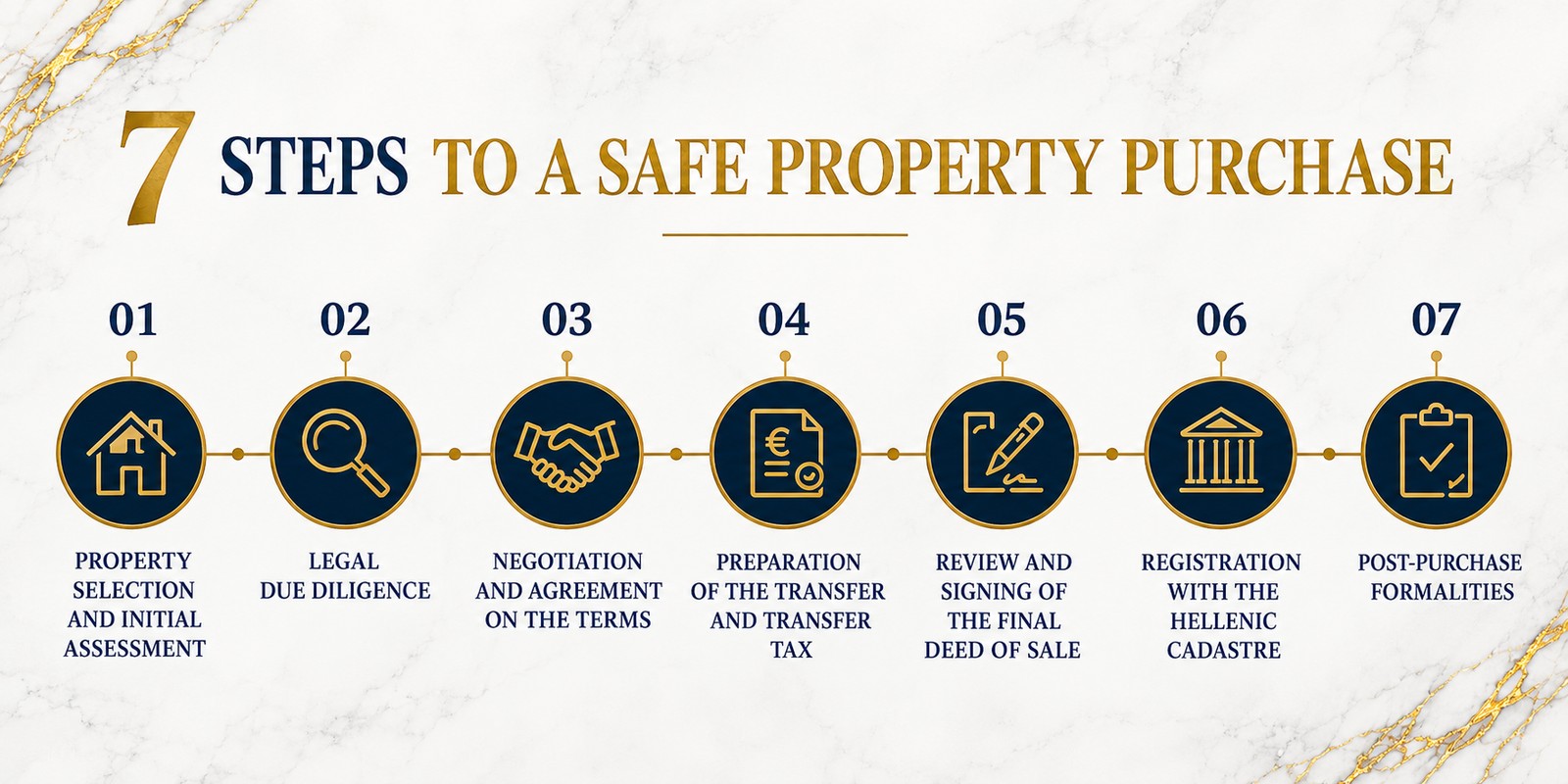
1. Property Selection and Initial Assessment
Once a property has been selected, the buyer should avoid entering into binding commitments or making substantial payments before the necessary checks have been completed.
At this stage, essential information about the property and the seller is collected, while the lawyer examines the structure of the transaction, the proposed terms, and any matters that require investigation before the purchase proceeds.
At the same time, where necessary, an engineer assesses the property’s physical condition and compliance with planning and building regulations.
2. Legal Due Diligence of the Property
This is one of the most important stages of the property acquisition process.
The buyer’s lawyer examines the title deeds and the relevant records held by the competent Cadastral Office to establish who legally owns the property and whether there are any encumbrances or third-party rights that could affect its transfer.
Depending on the circumstances, the legal due diligence may include examining:
- The title deeds and the chain of previous transfers of ownership.
- Mortgages and prenotations of mortgage (pre-notations of security).
- Attachments and seizures.
- Third-party claims or other registrable rights.
- The property’s cadastral registration status.
- Any outstanding legal matters that could affect the transaction.
Legal due diligence is distinct from technical due diligence, which is conducted by an engineer and covers, among other matters, the building permit, architectural plans, property measurements, unauthorized constructions or changes of use, and general compliance with planning and building regulations.
Combining legal and technical due diligence enables the buyer to understand precisely what they are purchasing and whether the property can be acquired safely.

3. Negotiation and Agreement on the Transaction Terms
Provided that the results of the due diligence are satisfactory, the lawyer negotiates or reviews the terms under which the purchase will proceed.
If a deposit is to be paid, or a private agreement or notarial preliminary agreement is to be signed, it is particularly important that the relevant document is reviewed by a lawyer beforehand.
The purchase price, payment method, deadlines, conditions for completing the transaction, and consequences of any legal or technical issues must be clearly defined. The agreement should also specify what happens if either party fails to fulfil its obligations.
A deposit should not be treated as a mere formality. The terms governing its payment largely determine whether, and under what circumstances, it may be refunded.
4. Preparation of the Property Transfer and Transfer Tax
The next stage involves preparing the final deed of sale.
The notary collects the documentation required for the transfer, while the buyer’s lawyer oversees the process and ensures that any issues identified during due diligence have been resolved before signing.
Before the deed is signed, a Real Estate Transfer Tax declaration must be submitted through the Independent Authority for Public Revenue (AADE), and the buyer must pay the applicable tax.
The standard Real Estate Transfer Tax rate is 3% of the property’s taxable value. An additional levy in favour of municipalities and communities is imposed on the principal transfer tax.
Costs and Taxes When Buying Property in Greece
Understanding the total cost of acquisition beyond the property price is essential for budgeting. The main costs include:
- Property Transfer Tax: Currently 3.09% of the property’s assessed or declared value (whichever is higher)
- Notary Fees: Approximately 0.8%–1.5% of the property value
- Legal Fees: Typically 1%–2% of the property value for full legal representation
- Land Registry Fees: Approximately 0.5%–0.7% for registration of the deed
- Engineering Assessment: Variable, typically €500–€2,000 depending on property size
In total, buyers should budget approximately 7%–10% above the purchase price for all associated transaction costs.
5. Review and Signing of the Final Deed of Sale
The final deed of sale is drafted by a notary.
Before signing, the buyer’s lawyer carefully reviews the draft deed to ensure that the property description, purchase price, payment arrangements, declarations made by the parties, and all other contractual provisions accurately reflect the agreed terms and the findings of the preceding legal due diligence.
Upon signing, the purchase price is paid in accordance with the agreed terms, and the notarial stage of the transaction is completed.
For buyers residing abroad, a substantial part of the process can be carried out through an appropriately executed power of attorney, provided that the necessary powers have been granted.
6. Registration with the Hellenic Cadastre
Signing the deed of sale is not the final step.
The deed must be submitted for registration with the competent Cadastral Office, and the applicable registration fees must be paid.
Once the registration process has been completed, it is essential to verify that the deed has been duly registered and that the buyer’s ownership rights are accurately reflected in the cadastral records.
The lawyer also oversees this stage, ensuring that the transaction is not considered complete merely because the deed of sale has been signed.
7. Post-Purchase Formalities
Following completion of the property transfer, certain practical and tax-related formalities must be addressed.
Depending on the circumstances, these may include verifying that the buyer’s property holdings have been correctly updated in the records of the Independent Authority for Public Revenue (AADE), as well as transferring or activating electricity, water, and other utility services.
In many property transactions processed through the myPROPERTY platform, the E9 property declaration is automatically generated using the transaction details. Nevertheless, the buyer should verify that the property’s tax records have been updated correctly.
Why Legal Representation Is Essential When Buying Property in Greece
Purchasing property involves much more than simply signing a deed of sale.
The notary prepares the notarial deed, while the engineer examines the property’s technical condition and compliance with planning and building regulations. The buyer’s lawyer, however, is the professional who acts exclusively to protect the buyer’s interests.
From the initial legal due diligence and negotiation of deposit terms to reviewing the final deed and ensuring its proper registration, the lawyer’s role is to identify legal risks before the buyer commits substantial funds or acquires a property affected by legal issues.
SF Legal Law Firm
SF Legal Law Firm provides comprehensive legal assistance to property buyers and investors throughout every stage of acquiring real estate in Greece, from initial legal due diligence and negotiation of transaction terms to signing the deed of sale and completing the transfer of ownership.
For clients residing abroad, the process can, where legally permissible, be arranged through a power of attorney, significantly reducing the need for their physical presence in Greece.