

 By Spanos Theodoros · · Updated
 The 90th Thessaloniki International Fair brought to the forefront an important announcement concerning the Greek real estate market and, more specifically, residential property purchases by persons from third countries. As part of the measures presented to address the housing issue, the Government announced its intention to increase the property transfer tax on residential properties from 3% to 15% for certain categories of buyers from outside the European Union, with July 2027 as the intended timeframe for implementation.
The announcement is undoubtedly significant, particularly for the international investment community; however, at this stage it should be approached with due caution, as it has not yet been incorporated into enacted legislation. In other words, the general direction of the measure is now known, but the conditions for its application, the exemptions, the transitional arrangements, and the specific categories of persons or transactions that will ultimately be subject to the increased rate have not yet been defined with the required degree of clarity. This means that the framework as it currently stands may not necessarily be identical to the framework that will apply once the measure takes its final legislative form.
From 3% to 15%: a substantial change in the cost of purchasing a residential property
According to the information announced to date, the basic property transfer tax applicable to transactions falling within the new regime will increase from 3% to 15%. If the municipal levy is also taken into account, which corresponds to 3% of the main tax, the overall tax burden effectively increases from 3.09% to 15.45% of the taxable value of the property.
The difference is clearly significant. For example:
- For a residential property with a taxable value of €200,000:
3.09% → €6.180 | 15.45% → €30.900 - For a taxable value of €350,000:
3.09% → €10.185 | 15.45% → €54.075 - For a taxable value of €700,000:
3.09% → €21.630 | 15.45% → €108.150
These examples illustrate the scale of the announced change, but they do not answer the crucial question of precisely which buyers and which transactions will ultimately be subject to the increased rate. This distinction is essential, because the announcement does not generally concern every foreign buyer or every type of investment in Greek real estate.
The announcement concerns residential properties, not every type of property
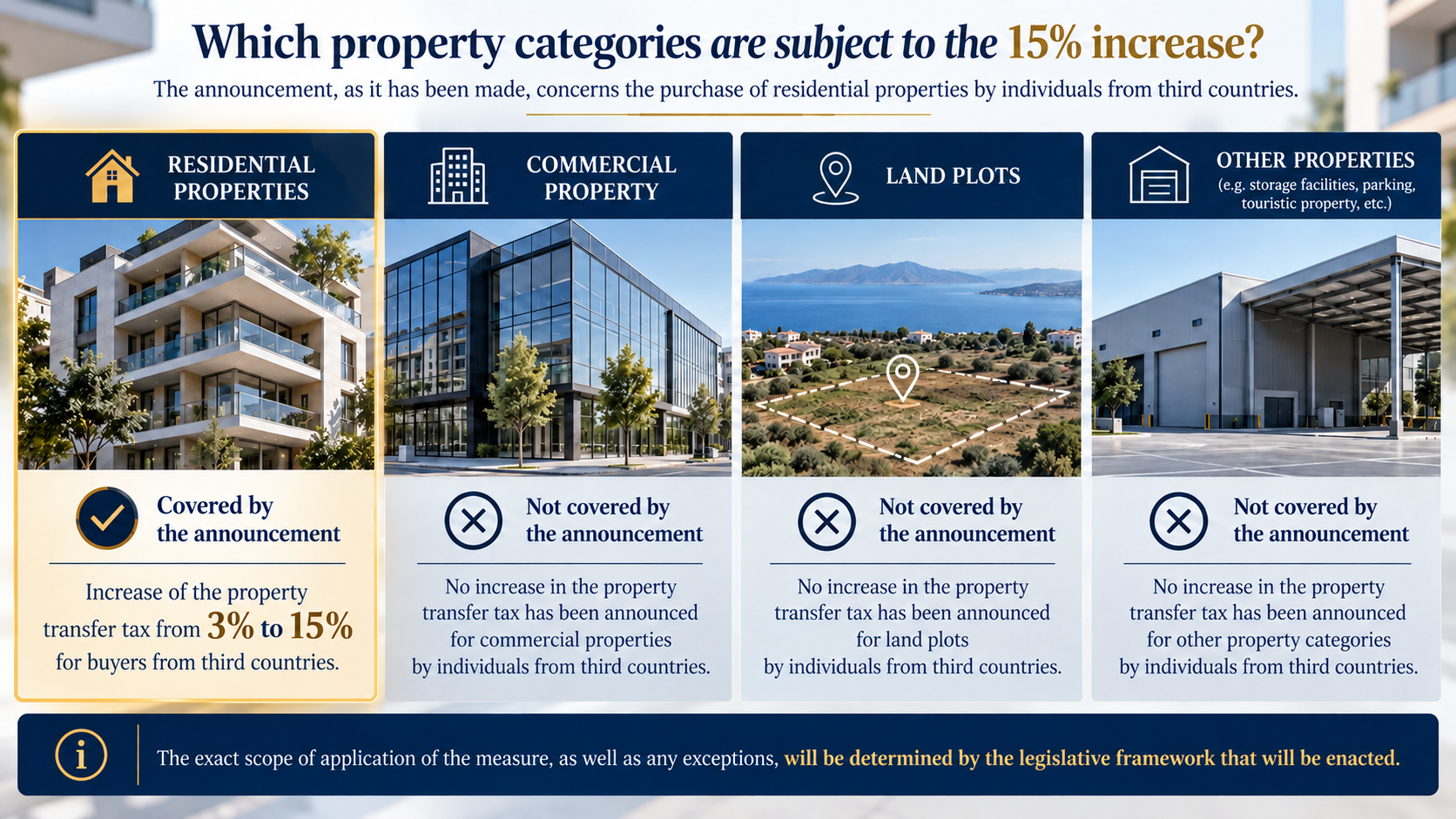
One of the key clarifications already provided is that the tax increase concerns the purchase of residential properties and not commercial premises, land plots, or other categories of real estate. This distinction is particularly important for international investors, since the Greek real estate market offers a wide range of investment options and is not limited to the acquisition of residential property.
A foreign investor may, for example, be interested in a commercial property, a tourism-related property, a land plot, or another investment structure, without the current announcement indicating that all such categories will be subject to the same increased tax treatment. Accordingly, this is not a horizontal increase in the taxation of all properties acquired by persons from third countries, but rather a targeted intervention which, as presented to date, focuses specifically on the purchase of residential properties.
Who exactly will be considered a buyer from a third country?
One of the most important issues that remains open concerns the precise identification of the persons who will be subject to the new rate. The official announcement generally refers to buyers from third countries, namely persons from outside the European Union and the European Economic Area, while the Government’s further explanation also refers to specific categories that appear to be exempt, such as EU and EEA citizens and long-term residents.
The point that requires further clarification is which legal criterion will ultimately determine whether a person is subject to the increased tax. Will it be based exclusively on the buyer’s nationality, will the buyer’s tax residence be taken into account, will the type of residence permit held by the buyer be relevant, or will a combination of several criteria apply? The answer is decisive, because different personal and tax circumstances may lead to different outcomes.
The distinction between nationality and tax residence
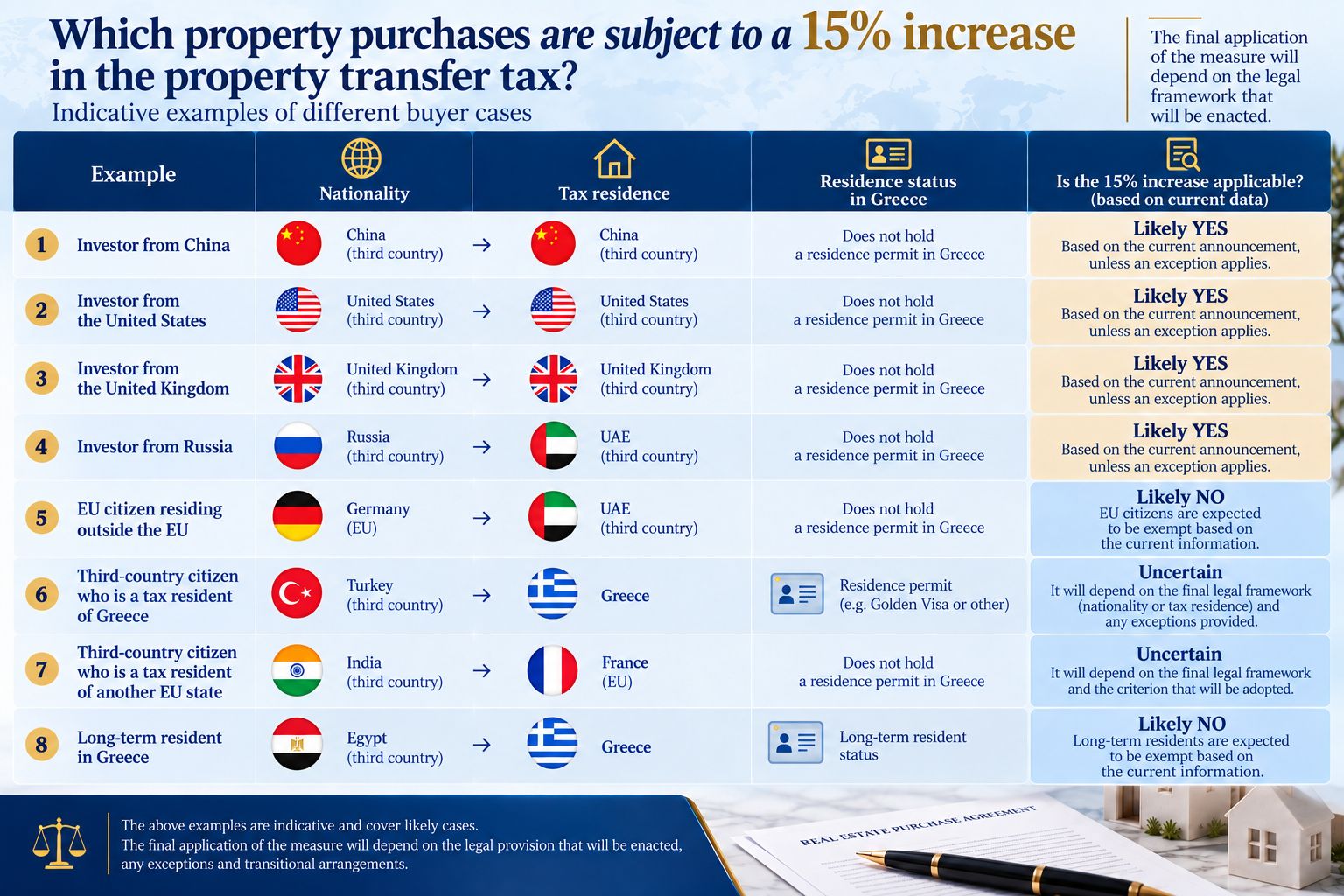
The need for clear legislative drafting becomes even more apparent when specific examples are considered.
An American / Chinese / Turkish / Israeli national who is also a tax resident of the United States / China / Turkey / Israel appears, based on the current direction of the announcement, to fall within the category of persons who could be affected by the new measure, provided that he or she purchases a residential property and does not fall within a specific exemption. This is the most straightforward case, since both nationality and tax residence point to a third country.
The position changes, however, where the same American / Chinese / Turkish / Israeli national is a tax resident of Greece. In that case, the person remains a third-country national but is no longer a tax resident of a third country. If the final legislation uses nationality as the principal criterion, this case may fall within the scope of the new tax. If, on the other hand, greater weight is given to tax residence, the outcome may be different.
An even more illustrative example is that of an American / Chinese / Turkish / Israeli national who is a tax resident of France. In this case, the person is a third-country national but has tax residence in a Member State of the European Union. Conversely, a French or German citizen may be a tax resident of the United Arab Emirates or another third country. These examples demonstrate that a simple distinction between “EU” and “non-EU” is not, on its own, sufficient to capture the full range of situations that may arise in practice.
What does the term “long-term resident” mean?
The official Government clarification refers to long-term residents, which makes a further explanation necessary. The term does not simply refer to a person who has lived in Greece for a long period of time, but to a specific legal residence status that is acquired subject to certain conditions and confers specific rights.
For this reason, it should not be assumed that every foreign national holding a Greek residence permit is automatically treated as a long-term resident. This distinction is particularly important when considering Golden Visa holders and other categories of investors who already hold lawful residence status in Greece.
What may apply to Golden Visa holders

To date, no specific exemption has been announced for Golden Visa holders. However, this does not mean that a definitive conclusion has already been reached that all Golden Visa holders will necessarily be subject to the increased rate.
The final assessment will depend on the precise wording of the relevant provision and on whether the legislator chooses to take into account nationality alone, tax residence, the type of residence permit, or a combination of those factors. Specific exemptions or distinctions may also be introduced for certain categories of residence permits, something that at present can neither be confirmed nor ruled out.
For an investor who already holds a Golden Visa and is considering a new property purchase in 2027 or later, the appropriate approach is therefore not to assume either that the new tax will apply or that the investor will be exempt from it, but rather to await the final legislative framework and assess the transaction in light of the investor’s personal and tax circumstances.
What will happen in the case of properties undergoing a change of use?

Particular interest also arises in relation to properties that are purchased as commercial premises and subsequently converted into residential properties. This is an area of particular practical relevance to Golden Visa investments as well, given that the conversion of commercial premises into residential use is already a recognised form of investment utilisation.
If, for example, a foreign investor purchases a shop or office and subsequently lawfully converts it into a residential property, it is not yet clear which use of the property will be taken into account for the purposes of applying the tax. Will the relevant criterion be the property’s use on the date of the contract, the use it acquires following the conversion, the existence of an already approved change of use, or the purchaser’s intention to carry out the conversion after the acquisition?
The answer to this issue may significantly affect the structuring of many investment transactions and, for that reason, it is one of the matters that will need to be expressly clarified in future legislation.
Purchases through Greek or foreign companies
The treatment of investments made through legal entities also remains an open issue. To date, it has not been clarified how cases will be treated where the residential property is acquired not by an individual, but by a Greek or foreign company, particularly where the ultimate beneficial owner or the person exercising ultimate control is a citizen or tax resident of a third country.
The final legislation may limit the application of the measure exclusively to individuals or, alternatively, may include specific provisions for corporate structures and cases that could be regarded as circumventing the purpose of the provision. Until the relevant bill is published, it would not be prudent to regard any particular tax treatment of corporate acquisitions as settled.
The purpose of the purchase may also be relevant
Another issue that may require clarification is the purpose for which the property is acquired. A purchase made exclusively for investment exploitation is not necessarily the same as the purchase of a home by a foreign national who has permanently settled in Greece, a purchase made within the Golden Visa framework, or an acquisition forming part of a broader family or business plan.
The announcement has a clear housing-policy orientation and is linked to limiting additional demand for residential property. It is not yet known, however, whether the final legislation will treat all of the above situations in the same manner or whether it will provide for distinctions depending on the substantive nature of the transaction.
What will apply to transactions already commenced before implementation?
One of the most important practical issues for investors planning transactions over the coming months concerns the transitional provisions. It is quite possible that cases will arise in which the purchase agreement has been entered into before the new regime begins to apply, a deposit has already been paid, or a preliminary agreement has been signed, but the final deed of sale is completed after the date on which the new regime enters into force.
In such cases, it will be necessary to determine which point in time will be decisive for the calculation of the tax. Will the relevant date be the date of the preliminary agreement, the date on which the deposit was paid, the filing of the property transfer tax return, or exclusively the date of the final deed of sale? It will also be necessary to determine whether specific protection will be introduced for transactions that have already progressed substantially before the change in regime.
These transitional arrangements may prove decisive for many investments currently being planned with completion anticipated in 2027.
Why is the change being introduced?
The Government has linked the announcement to the broader housing issue and to the need to limit the pressure created by increased demand for residential property. According to the figures presented, significant investment from third countries was made in the Greek real estate market in 2025, a large proportion of which was directed towards residential property.
The rationale behind the intervention is that additional external demand may contribute to rising prices and restrict permanent residents’ access to the housing market. For this reason, the tax increase is presented as a housing-policy measure rather than as a general change in approach towards foreign investment.
This distinction is particularly important, as the Greek market continues to offer a broad range of investment options beyond the straightforward purchase of residential property.

The announcement does not diminish the investment potential of the Greek market
The announcement of the tax increase is clearly a development that should be incorporated into a foreign investor’s planning; however, it would not be correct to interpret it as an across-the-board burden on every investment or as an indication that Greece is moving away from the international investment market.
To date, a targeted measure has been announced that specifically concerns the purchase of residential properties by certain categories of persons. At the same time, investment opportunities continue to exist in commercial properties, land plots, tourism-related properties and other categories of assets, while several issues remain open regarding exemptions, residence permits, tax residence, change of use and corporate structures.
Accordingly, the appropriate approach for an international investor is not to dismiss the Greek market, but to place even greater emphasis on the proper legal and tax structuring of the transaction before completion.
What should an investor take away at this stage?
The key conclusion is that we now know the general direction of the Government’s intervention, but not its final form. The intention to increase the property transfer tax on residential properties from 3% to 15% has been announced with July 2027 as the intended timeframe, but the relevant provision has not yet been enacted and the categories of persons and transactions that will fall within its scope have not yet been comprehensively defined.
Until the legislation is finalised, significant clarifications may be introduced regarding nationality, tax residence, residence permits, Golden Visa holders, purchases through companies, properties undergoing a change of use, and transactions that have already commenced before the new regime begins to apply.
For this reason, it would be premature at this stage to assume that every buyer from a third country will automatically be subject to a 15% tax on every purchase of a residential property. The final scope of the measure will only become clear once the bill is published and, subsequently, once the final legislative provision is enacted.
For investors considering the Greek market with a timeframe extending into 2027 and beyond, the period before the measure is implemented should be used for timely information and careful planning, as it is entirely possible that the final legislative framework will include exemptions, distinctions or transitional arrangements that have not yet been announced. Greece therefore continues to be a market offering significant investment opportunities, with the difference that the precise structuring of each transaction will become even more important once the new framework takes its final form.