
 By Spanos Theodoros · · Updated
A residential lease does not merely grant rights to the tenant; it also creates specific obligations concerning payment of rent, use of the property, and conduct towards other residents.
In practice, however, the boundaries are not always self-evident.
When does deterioration constitute normal wear and tear, and when does it amount to improper use? Are neighbours’ complaints sufficient to have a tenant removed? What happens when rent is repeatedly left unpaid? And, ultimately, in which circumstances may a landlord lawfully seek recovery of possession of the property?
The answer depends in each case on the grounds for terminating the lease, the terms of the tenancy agreement, the parties’ conduct, and the available evidence.
What Does “Proper Use” of the Leased Property Mean?
The tenant is entitled to use the dwelling for the purpose for which it was provided. At the same time, the tenant must exercise the required degree of care and comply with the agreed terms.
This does not mean that, after years of occupation, the tenant must return the property in the same condition as on the first day.
The Greek Civil Code provides that a tenant is not liable for deterioration or alterations resulting from the agreed use.
A clear distinction must therefore be drawn between normal wear and tear arising from occupation and damage caused by culpable or negligent conduct on the tenant’s part.
Example
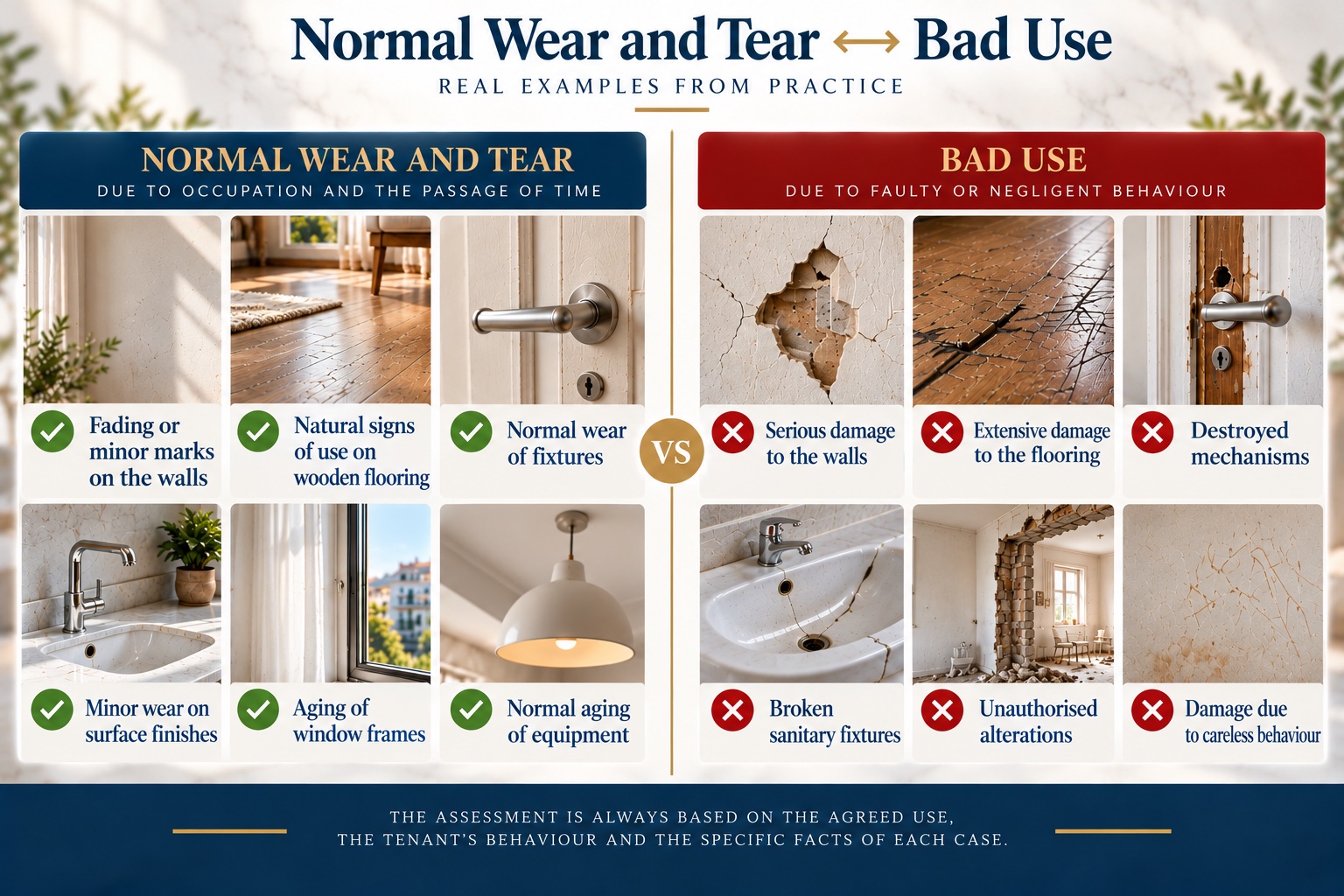
A tenant has lived in the same apartment for six years. Over time, the walls need repainting and the wooden flooring shows ordinary signs of use.
Such deterioration does not automatically constitute improper use.
The situation would be different if the tenant caused serious damage or, without the required consent, carried out substantial alterations affecting the layout of the property.
When Does Improper Use of the Leased Property Occur?
Article 594 of the Greek Civil Code is the principal provision governing improper use of leased property.
Under that provision, the landlord may terminate the lease with immediate effect and claim damages if the tenant, despite the landlord’s objections, fails to use the leased property with due care and in accordance with the agreement, or fails to behave appropriately towards other residents.
Case law distinguishes three principal situations:
1. Use without the required degree of care
This may include serious damage to or destruction of parts of the property, as well as unauthorised alterations substantially changing its layout, arrangement or appearance.
2. Use contrary to the agreed terms
The tenant must use the property in accordance with its agreed purpose and any lawful contractual restrictions.
3. Inappropriate conduct towards other residents
A tenant’s conduct within an apartment building is legally relevant. The Civil Code expressly identifies it as one of the circumstances that may, subject to the statutory requirements, justify termination of the lease.
What Does Actual Case Law Tell Us About Improper Use?
Case law is particularly important because it demonstrates that conduct is not characterised as “improper use” in the abstract.
In Supreme Court judgment No. 881/2021, the Greek Supreme Court (Areios Pagos) reiterated that Article 594 of the Civil Code covers three independent situations: use without due care, use in breach of agreed terms, and inappropriate conduct towards other residents.
Importantly, case law assesses improper use by reference to the tenant’s conduct and the objectively required standard of care of a prudent person.
It is therefore insufficient for a landlord merely to allege that a tenant “does not look after the home”. There must be specific facts capable of assessment and proof.
Complaints from Other Residents: Can They Lead to Eviction?
The existence of complaints from other residents does not automatically mean that a tenant can be removed from the dwelling.
An isolated complaint, a personal disagreement between neighbours or an occasional incident does not, in itself, amount to improper use within the meaning of Article 594 of the Civil Code.
The position differs where serious or repeated conduct breaches the tenant’s obligation to behave appropriately towards other residents and continues despite the landlord’s objections.
Example
Suppose a tenant repeatedly causes serious disturbances during designated quiet hours. Several residents complain, the landlord informs the tenant of the complaints and asks for the conduct to stop, but the incidents continue.
This situation is materially different from a single noise complaint.
To determine whether the requirements of Article 594 of the Civil Code are met, the nature and seriousness of the incidents, their recurrence, previous objections, the continuation of the conduct and the available evidence will be examined.
Complaints Must Be Substantiated
In a tenancy dispute, a general assertion that “everyone in the building is complaining” is not enough.
The court examines specific facts and evidence.
Depending on the circumstances, admissible evidence may include written complaints, formal extrajudicial notices, witness testimony, documents relating to particular incidents and other material establishing what actually occurred.
This protects both parties.
The landlord can establish genuinely problematic and repeated conduct, while the tenant is protected against losing the tenancy solely on the basis of vague or unsubstantiated allegations.
A Real Case Illustrating the Importance of Evidence
Piraeus Court of Appeal judgment No. 135/2024 concerned commercial rather than residential premises but clearly illustrates how courts examine allegations of improper use.
The landlords alleged, among other things, that the tenant had made unauthorised alterations to the property and used the premises in a manner different from that agreed.
The court carefully examined the contract, witness testimony, technical reports, photographs and the landlords’ own conduct. It was found, among other things, that the tenant had a contractual right to make certain alterations, while the owners knew about the works, monitored them and had raised no objections.
The example is also relevant to residential leases: whether an action constitutes “improper use” depends not merely on one party’s allegations, but on the agreement, the facts and what can be proved.
When Is a Tenant Protected?
A tenant who lawfully uses the dwelling and fulfils their obligations is protected against arbitrary eviction.
A landlord cannot simply decide that the tenant must leave and remove them through private action.
For example, the landlord cannot arbitrarily change the locks to deny the tenant access to and possession of the dwelling, or personally remove the tenant’s belongings in order to recover possession.
If the tenant does not voluntarily surrender the property, the landlord must follow the lawful procedure.
Tenant protection also extends to the condition of the property. The landlord must deliver and maintain the leased property in a condition suitable for the agreed use. If an actual defect arises during the lease that wholly or partly prevents the agreed use, the Civil Code grants the tenant specific rights depending on the circumstances and seriousness of the problem.
When Can a Tenant Be Evicted?
The term “eviction” is commonly used in everyday language, but legally it is necessary to examine the grounds on which recovery of possession is sought.
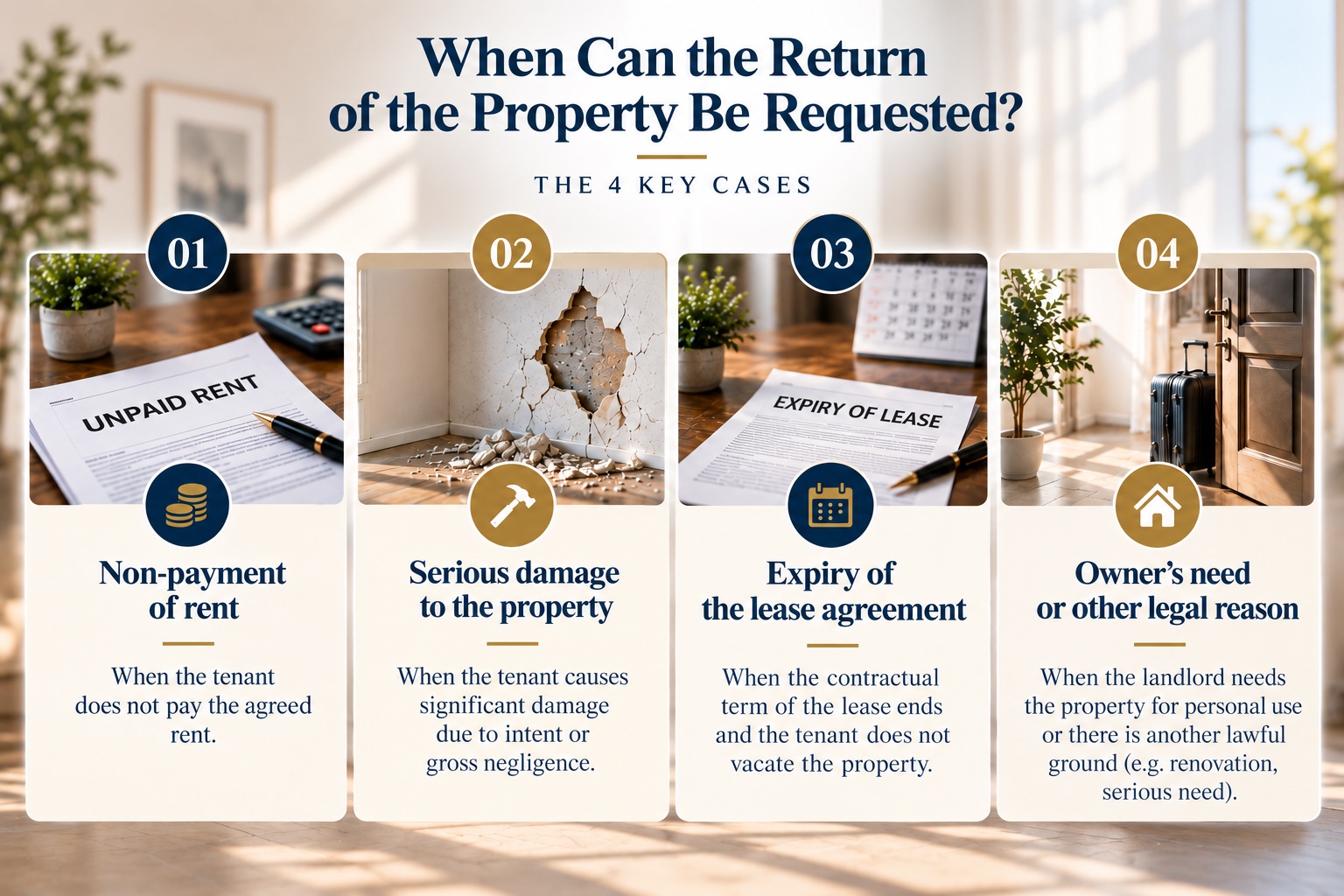
The main situations relevant to residential tenants are distinct:
- delay or failure to pay rent,
- improper use of the property or use in breach of the lease,
- conduct towards other residents falling within Article 594 of the Civil Code,
- and expiry of the lease without surrender of the property.
The legal basis and procedure are not necessarily the same in all these situations. For example, the special order for recovery of possession due to persistent failure to pay rent concerns late payment of rent. Improper use under Article 594 of the Civil Code is addressed through termination of the lease and, if the tenant does not surrender the property, the corresponding judicial proceedings for recovery of possession.
What Happens When a Tenant Fails to Pay Rent?
Late payment or non-payment of rent is a separate issue from improper use of the dwelling.
The Civil Code entitles the landlord to terminate the lease where the tenant is in arrears with all or part of the rent, subject to the conditions of Article 597 of the Civil Code.
In parallel, the Greek Code of Civil Procedure provides for a special procedure for obtaining an order for recovery of possession of leased property on grounds of culpable non-payment. Under this procedure, where commencement of the lease is evidenced in writing, a written demand must be served on the tenant by a judicial bailiff at least fifteen days before the application is filed.
If the tenant pays the outstanding rent within that fifteen-day period and payment is evidenced in writing, the issue of a recovery order for that particular default is, in principle, precluded.
There is, however, an important exception: repeated culpable delay in paying rent. In that situation, payment after a further default does not afford the tenant the same protection. Furthermore, Article 637 of the Code of Civil Procedure, as currently in force, provides that a written demand is required only on the first occasion.
Actual Case: Repeated Late Payment of Rent
Case law illustrates why the concept of “repeated culpable delay” matters.
In a case brought before the Greek Supreme Court (judgment No. 1449/2025), the tenant company had repeatedly delayed paying rent and, according to the facts of the case, rent was outstanding for eight months.
The tenant subsequently paid the arrears. The matter did not, however, end there: the separate ground of repeated culpable delay was examined, and the Court of Appeal had ordered recovery of possession on that basis.
Although this was a commercial lease, the judgment highlights a broader principle relevant to residential leases: the law distinguishes an isolated delay remedied in time from a repeated pattern of late rent payments.
Improper Use and Non-Payment: Two Different Situations
It is important not to confuse them.
A tenant may pay the rent on time every month but cause serious damage to the property or repeatedly breach obligations towards other residents.
Conversely, a tenant may keep the dwelling in excellent condition but fail to pay rent.
Both situations may, if the statutory requirements are satisfied, result in recovery of possession, but the legal grounds and procedures differ.
What Happens When the Lease Simply Expires?
Recovery of possession may also be sought because the lease has expired, even where there has been neither improper use nor any rent arrears.
Article 637 of the Code of Civil Procedure, as currently in force, now also allows a recovery order to be issued upon expiry of a fixed-term lease, and where a fixed-term lease has become indefinite following its expiry, provided the statutory requirements are met.
For a fixed-term lease, the requirements include a formal extrajudicial demand to surrender the property at least three months before the lease expires.
Where a fixed-term lease has become indefinite following its expiry, the formal extrajudicial demand must be served at least three months before the application for a recovery order is submitted.
Accordingly, a tenant may have fully complied with all obligations and nevertheless be legally required to surrender the property once the lease has expired and the prescribed procedure has been followed.
What Rights Does a Tenant Have When a Recovery Order Is Issued?
The issue of a recovery order does not mean that the tenant is deprived of all avenues of judicial protection.
The current legal framework provides the right to challenge the order within fifteen working days of its service.
The order constitutes an enforceable title, but the law prescribes specific periods before enforcement may take place. Where recovery is based on expiry of the lease, the current framework provides for a longer period before enforcement.
Service of a recovery order therefore requires prompt legal assessment by both landlord and tenant.
Five Examples to Clarify the Distinction
Normal wear and tear:
After several years of occupation, repainting is needed and the flooring shows ordinary signs of use. This does not, by itself, constitute improper use.
Serious damage caused by the tenant:
The tenant causes substantial destruction or carries out significant unauthorised alterations and continues despite the landlord’s objections. This may give rise to a right to terminate the lease and claim damages.
Isolated complaint:
A neighbour complains once about noise. That fact does not automatically establish a right to evict.
Repeated serious disturbance:
There are recurring incidents, multiple complaints and supporting evidence, and the tenant continues despite the landlord’s objections. Depending on the facts, Article 594 of the Civil Code may then become applicable.
Repeated late payment of rent:
The tenant consistently pays only after receiving a demand or after the landlord initiates legal action. This situation is not treated in the same way as an isolated delay.
The Decisive Factors Are the Facts and the Evidence

In tenancy disputes, general labels such as “bad tenant”, “improper use” or “disturbs everyone in the building” are insufficient.
The following must be examined:
- what exactly happened,
- whether the incident was isolated or repeated,
- what the tenancy agreement provides,
- whether the required objections or demands were previously made,
- whether the conduct continued,
- and, above all, what can be proved.
This protects both landlord and tenant.
The landlord has the right to protect their property and seek recovery of possession where the statutory conditions are met. The tenant, on the other hand, is protected against arbitrary action and the loss of their home without the procedure prescribed by law.
Legal Support in Landlord – Tenant Disputes
Disputes concerning improper use of a dwelling, rent arrears or problems with other residents require individual assessment, since situations that initially appear similar may have different legal consequences.
SF Legal provides legal assistance to landlords and tenants in reviewing tenancy agreements, assessing incidents of improper use, drafting and serving formal extrajudicial notices and demands, recovering outstanding rent, pursuing proceedings for recovery of possession, and resolving disputes involving damage to property or tenant conduct.
Early legal assessment is essential: not every complaint justifies removing a tenant, and tenant protection does not mean that serious or repeated breaches go without consequences.