

 By Spanos Theodoros · · Updated
Residential leases are among the most common contractual relationships in Greece. Despite their prevalence, disputes frequently arise in practice concerning the duration of the lease, payment and adjustment of rent, the security deposit, repairs to the property, early departure by the tenant, and the return of possession of the property to the landlord.
For this reason, establishing the tenancy relationship properly from the outset is particularly important for both landlord and tenant. A clear and comprehensive lease agreement can precisely define the rights and obligations of both parties and significantly reduce the risk of future disputes.
What Is the Minimum Duration of a Residential Lease?
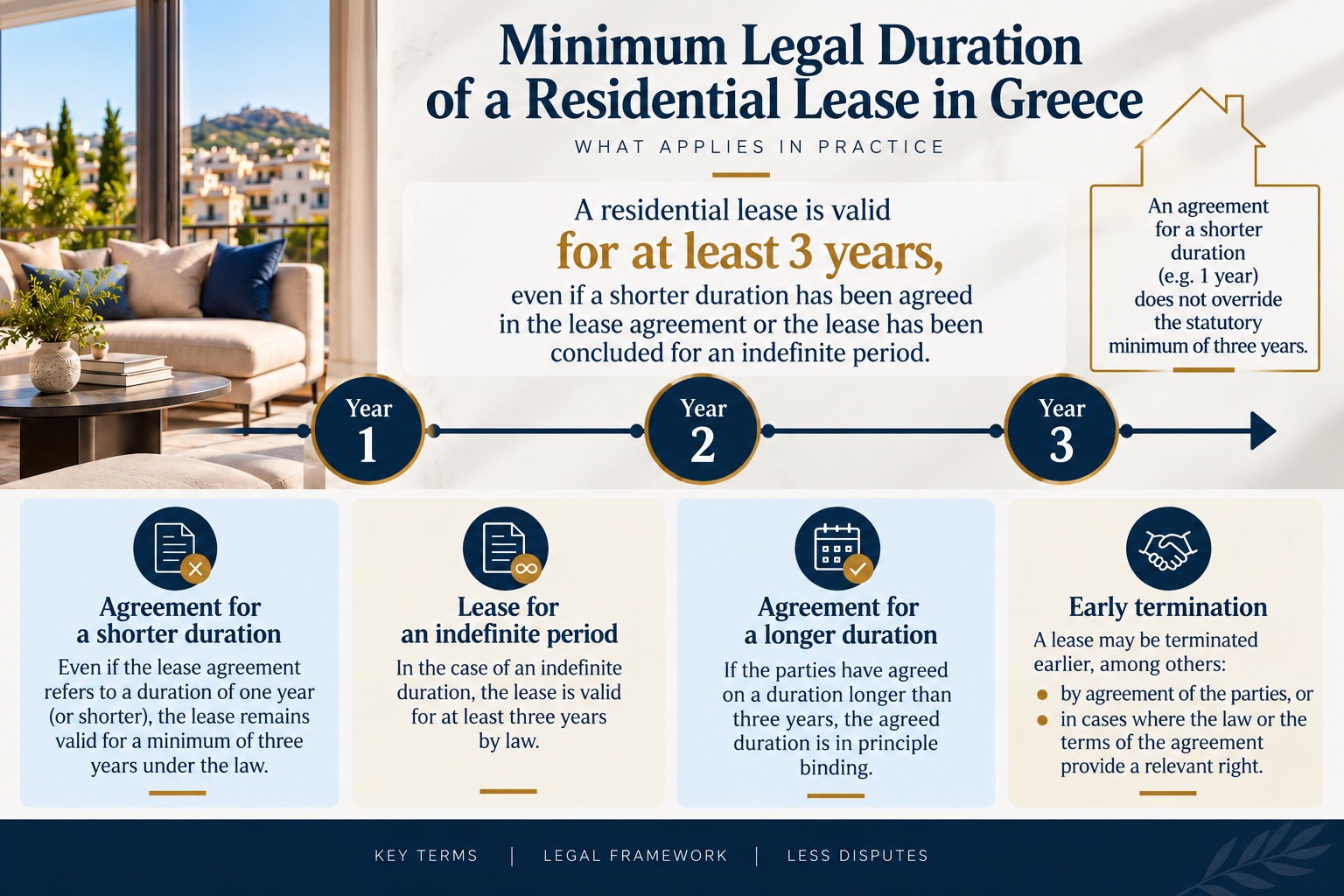
For properties used as a primary residence, the lease has a minimum duration of three years, even if the lease agreement specifies a shorter term or the lease has been concluded for an indefinite period.
Therefore, if, for example, a residential lease agreement provides for a one-year term, that provision does not override the statutory minimum three-year duration.
Conversely, if the parties have agreed on a term exceeding three years, the longer agreed term is, in principle, binding.
The statutory three-year minimum does not, however, mean that a lease can never be terminated earlier. Early termination may arise, among other circumstances, by agreement between the parties or where the law or the terms of the contract confer such a right.
For this reason, provisions concerning early departure, termination and their consequences must be drafted with particular care in the lease agreement.
Rent and Rent Adjustments
The amount of rent is determined by agreement between the landlord and the tenant.
It is equally important to specify clearly whether and how the rent will be adjusted during the lease term. The agreement may, for example, provide for a fixed percentage or another clearly defined adjustment mechanism.
A specific rent-adjustment clause substantially reduces future disputes. During the agreed lease term, the rent does not change merely because one party wishes to charge or pay a different amount; a contractual or statutory basis is required.
In exceptional circumstances, a substantial and unforeseeable change in conditions may give rise to judicial adjustment of the contractual relationship, provided the statutory requirements are met.
What Rules Apply to the Security Deposit?
When entering a residential lease, it is customary for the tenant to pay a security deposit.
The security deposit is intended to secure the landlord against non-performance of obligations arising from the lease. Accordingly, its amount, the circumstances in which it may be applied, and the conditions for its return should be clearly specified in the lease agreement.
Following the expiry of the lease and the return of possession of the property, the deposit is refunded provided that the landlord has no claims that may lawfully and contractually be satisfied from it, such as outstanding amounts or damage for which the tenant is responsible.
It is particularly important to distinguish damage from ordinary wear and tear. The tenant is not liable for deterioration resulting from the agreed and normal use of the property.
Furthermore, the security deposit should not automatically be treated as payment of the final month’s rent. This depends on the terms agreed between the parties.
What Are the Landlord’s Main Obligations?
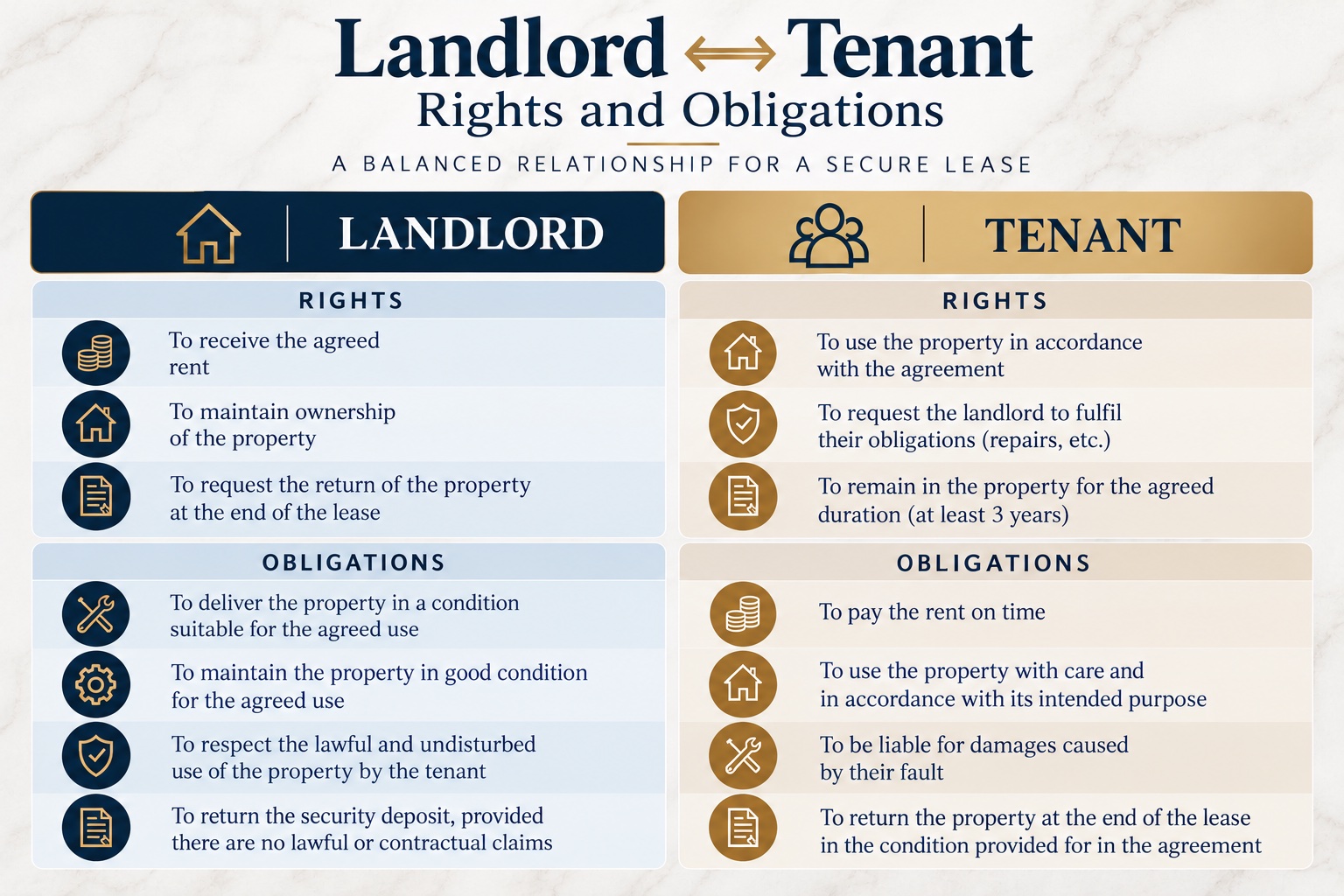
The landlord must deliver the property in a condition suitable for its agreed use as a residence and maintain it in a condition suitable for that use throughout the lease term.
This obligation becomes particularly important when serious defects or faults arise in the property. Responsibility for a repair cannot be determined solely by its category, for example, “plumbing” or “electrical”, but requires consideration of the cause of the fault, the use of the property, any fault attributable to the tenant, and the terms of the agreement.
If an actual defect arises that wholly or partly prevents the agreed use of the property, the law grants the tenant certain rights, depending on the circumstances of the case.
At the same time, the landlord must respect the tenant’s lawful and undisturbed use of the property. Ownership of the property does not mean that the landlord may freely enter the residence during the lease without the tenant’s consent or another lawful basis.
What Are the Tenant’s Main Obligations?
A fundamental obligation of the tenant is to pay the agreed rent on time.
The tenant must also use the property in accordance with the agreed purpose and with the requisite care. The tenant must refrain from acts that cause damage to the property and comply with the relevant contractual terms.
The tenant may be liable for damage caused through their own fault or by persons for whom they are responsible. However, the tenant is not liable for ordinary wear and tear arising from the agreed use of the property.
Upon expiry of the lease, the tenant must return the property in the condition in which it was received, allowing for deterioration resulting from ordinary use.
Matters such as subletting, granting use of the property to third parties, or making substantial alterations to the property must be assessed in light of both the lease agreement and the applicable legal provisions.
Electronic Declaration of the Lease to the AADE
Details of a long-term lease are declared electronically to the Independent Authority for Public Revenue (AADE) through its “Real Estate Lease Information Declarations” application.
The relevant declaration must be submitted by the end of the month following the commencement or amendment of the lease.
The electronic declaration records, among other details, information concerning landlords and tenants, the duration of the lease, the total monthly rent and the property details.
Where an Energy Performance Certificate (EPC) is required for the property concerned, the relevant details must also be entered into the electronic declaration.
The electronic declaration to the AADE should not be confused with the detailed private lease agreement. The agreement remains particularly important because it can regulate in detail matters not reflected in the electronic declaration.
What Happens if the Tenant Fails to Pay the Rent?
Late payment of rent may lead to termination of the lease and recovery of possession of the property, provided the prescribed legal procedure is followed.
For the issuance of an order for recovery of possession of leased premises on grounds of persistent non-payment, the commencement of the lease must, among other requirements, be evidenced in writing, and prior written notice must have been served by a court bailiff at least fifteen days before the application is filed.
If the outstanding rent is paid within that fifteen-day period and payment is evidenced in writing, issuance of the recovery order in respect of that default is, in principle, precluded. Different treatment applies in cases of repeated non-payment due to the tenant’s default.
In all cases, the landlord must not attempt to remove the tenant unlawfully, for example by changing the locks or removing the tenant’s personal belongings. Recovery of possession must be pursued through lawful procedures.
What Happens When the Lease Expires?
Expiry of the agreed lease term must not be confused with evicting the tenant from the property without following a lawful procedure.
Under the current legal framework, an order for recovery of possession of leased premises may also be issued on the grounds that the agreed term has expired, provided the statutory conditions are met.
In the case of a fixed-term lease, the commencement and expiry of the lease must be evidenced in writing, and the landlord must have served an extrajudicial notice demanding the return of possession of the property at least three months before the expiry of the agreed term.
If a fixed-term lease has become an indefinite-term lease following its expiry, the relevant extrajudicial notice must have been served at least three months before the application for a recovery-of-possession order is submitted.
Compliance with the prescribed notice periods is therefore particularly important for a landlord seeking to recover possession of the property after the lease expires.
What Happens if the Leased Property Is Sold?
The sale of a property during a lease does not automatically terminate the lease or require the tenant to vacate immediately.
Under the Greek Civil Code, where a property lease is evidenced by a document bearing a legally certain date, the new owner, in principle, succeeds to the rights and obligations under the existing lease, unless the lease agreement provides otherwise.
Conversely, where the relevant conditions are not satisfied or the lease agreement contains a specific provision addressing transfer of ownership, different rules may apply.
For this reason, before purchasing or selling any leased property, it is essential to examine carefully the existing lease agreement and the legal status of the tenancy.
This is particularly important in property investment transactions, as an existing lease may affect when and on what terms the new owner will obtain vacant possession of the property.
Why Is a Properly Drafted Lease Agreement Important?
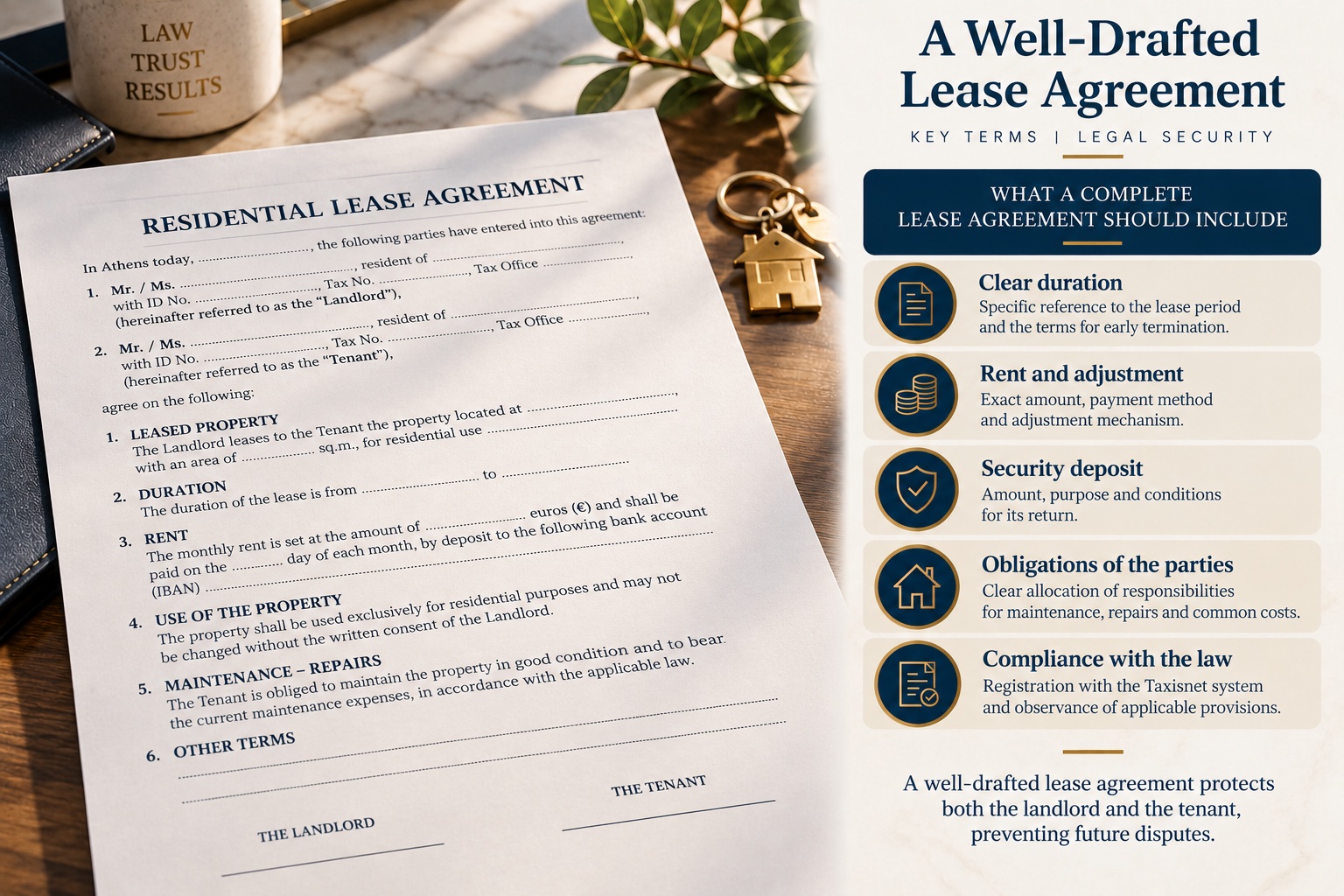
Many disputes between landlords and tenants could have been avoided if critical issues had been clearly addressed before the property was handed over.
A comprehensive residential lease agreement should be tailored to the particular property and the needs of the contracting parties and should clearly regulate, among other matters:
- the duration of the lease,
- the amount of rent and when it is payable,
- the mechanism for rent adjustments,
- the security deposit and the conditions for its return,
- the permitted use of the property,
- the allocation of expenses and repairs,
- the terms governing subletting or granting use to others,
- the consequences of late rent payments,
- the conditions for early termination,
- and the procedure for handover and return of possession of the property.
It is also particularly useful to record accurately the condition of the property and its equipment upon handover, to minimize future disputes over damage and ordinary wear and tear.
Careful drafting of the agreement before the lease begins is one of the most effective means of protecting both the landlord and the tenant.
Legal Support for Residential Leases
SF Legal provides comprehensive legal assistance to landlords, tenants and investors on matters concerning long-term residential leases in Greece.
Legal assistance may include drafting and reviewing lease agreements; amending or terminating contracts; preparing extrajudicial notices and demands; handling late or unpaid rent; recovery-of-possession proceedings; disputes concerning deposits, damage and repairs; and reviewing existing leases in connection with property purchases or sales.
Timely legal guidance and properly structured lease terms can protect the rights of the contracting parties and significantly reduce the risk of future tenancy disputes.