

 By Spanos Theodoros ·
Greece is an attractive option for entrepreneurs and investors from abroad who wish to develop business activities within the European Union. Access to the European single market, the country’s geographical location and the growth of important sectors of the Greek economy have increased interest in establishing and operating businesses in Greece.
A Greek company may be established by both foreign natural persons and foreign legal entities. However, where the founder, partner or shareholder is based abroad, the process involves certain particularities that should be examined before it begins.
Obtaining a Greek Tax Identification Number (AFM), choosing the appropriate legal form, preparing and legalising foreign documents, representing the investor in Greece and completing bank identification procedures are among the key matters that must be properly organised.
Can a Foreign National Establish a Company in Greece?
Foreign nationality does not, in itself, prevent a person from establishing or participating in a Greek company. Depending on the legal form chosen and the requirements laid down by law, foreign natural and legal persons may participate as founders, partners or shareholders.
However, a distinction must be made between citizens of European Union Member States and third-country nationals, since in the latter case additional issues may arise concerning the right to reside and engage in professional activity in Greece.
In particular, for third-country nationals, the ability to establish or participate in a Greek company must not be confused with the right to reside or work in the country. Holding company interests or shares does not, in itself, confer a residence permit or the right to work in Greece.
Accordingly, if an investor from a third country wishes not only to participate in the company but also to settle in Greece or take on an active managerial or professional role within it, the applicable immigration framework and its requirements must be examined separately.
Can a Foreign Company Participate in a Greek Company?
A company legally established abroad may participate as a partner or shareholder in a Greek company.
In this case, appropriate corporate and supporting legal documents must be provided, demonstrating, among other things, the foreign company’s lawful existence, its current legal representation and the authority of the person acting on its behalf.
Depending on the country of issue and the applicable international or EU framework, foreign public documents may require an Apostille or another prescribed legalisation procedure, as well as an official translation for use in Greece.
Alternatively, an existing foreign company may consider establishing a branch in Greece, rather than incorporating a new Greek legal entity, provided the relevant requirements are met.
Choosing the Appropriate Legal Form
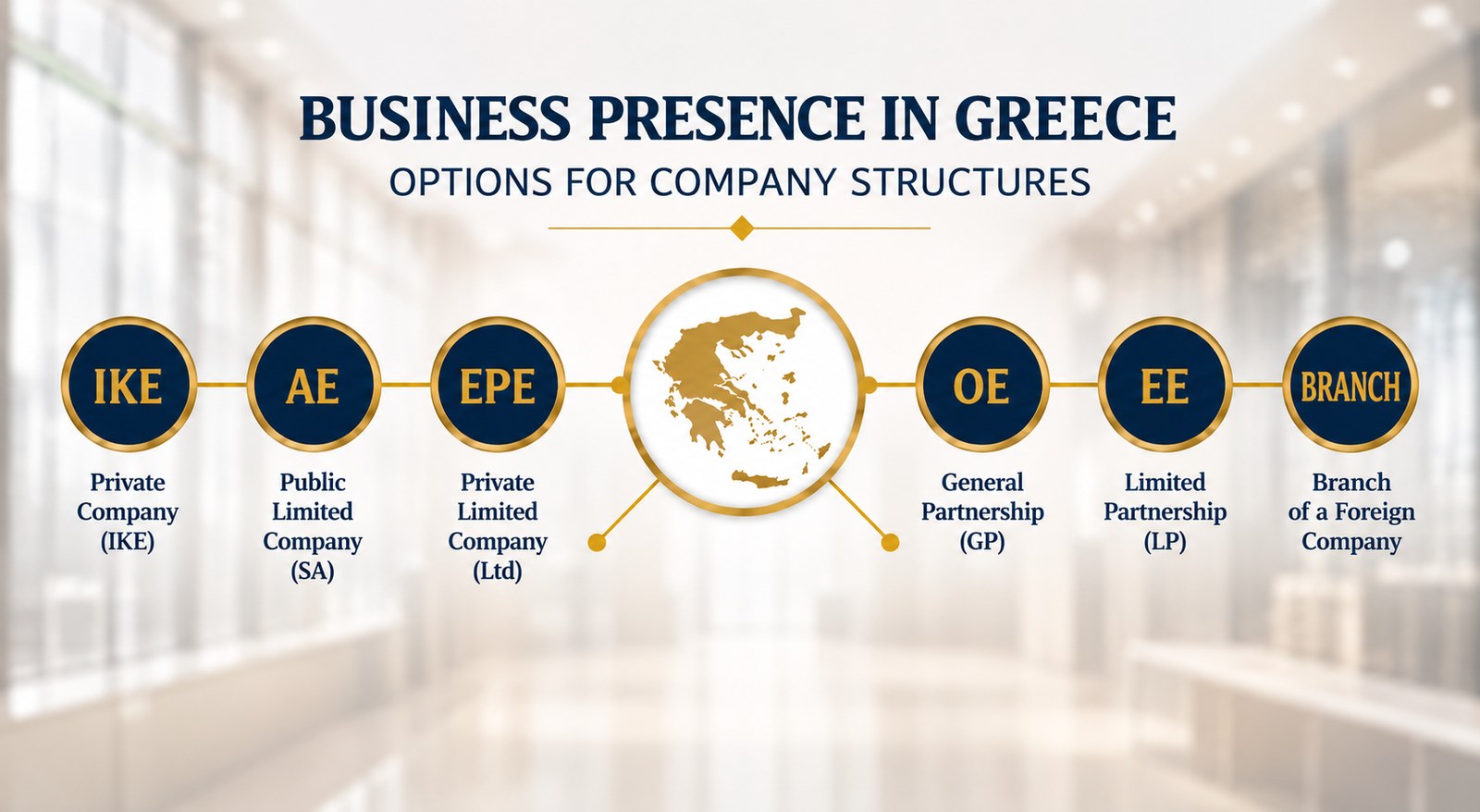
Choosing the legal form is one of the most important matters to consider before commencing business activities in Greece. Foreign investors are not restricted to a particular legal form on account of their nationality; provided the applicable statutory requirements are satisfied, they may choose among the forms of company recognised under Greek law.
The principal options are the Private Company (IKE), the Société Anonyme (AE), the Limited Liability Company (EPE), the General Partnership (OE) and the Limited Partnership (EE). For companies already established abroad, the establishment of a branch in Greece may also be considered.
1. Private Company (IKE)
The Private Company (IKE) is one of the most flexible legal forms under Greek law and is widely used by small and medium-sized businesses.
It may be established by a single person (single-member IKE) or by several partners. It has separate legal personality and, as a general rule, the company itself is liable for its obligations with its own assets, subject to specific exceptions provided by law.
One of its key characteristics is its particularly flexible internal organisation, making it suitable for many business activities and a frequent choice for foreign nationals seeking to establish a business presence in Greece.
2. Société Anonyme (AE)
The Société Anonyme (AE) is a company limited by shares with separate legal personality, mainly used for larger-scale businesses or investments requiring a more complex corporate and capital structure.
Its capital is divided into shares, and this legal form provides a more structured framework for investor participation and the admission of new investors.
It may therefore be suitable for larger investments, business ventures with multiple shareholders, or companies planning substantial growth and financing.
Compared with the IKE, the AE has a more complex corporate organisation and greater corporate compliance obligations.
3. Limited Liability Company (EPE)
The Limited Liability Company (EPE) is also a capital company with separate legal personality and may be established by one or more persons.
As a general rule, the company itself is liable for its obligations with its own assets. The partners’ participation is represented by company interests, and its operation is governed by its articles of association and the specific legislative framework applicable to EPEs.
Although the IKE is now a particularly popular option because of its flexibility, the EPE remains an available legal form and may be appropriate depending on the circumstances and business plan.
4. General Partnership (OE)
The General Partnership (OE) is a partnership and differs fundamentally from capital companies in terms of the partners’ liability.
Its most important characteristic is that the general partners are jointly and severally liable, without limitation, for the partnership’s obligations.
This is a simpler business structure, generally suitable where there is a close relationship and a high degree of trust between the partners. However, the extent of personal liability is a crucial factor to assess before choosing this form.
5. Limited Partnership (EE)
The Limited Partnership (EE) is also a partnership, distinguished primarily by having two different categories of partners.
At least one partner is a general partner with unlimited liability for the partnership’s obligations, while at least one is a limited partner whose liability is limited in accordance with the conditions laid down by law.
This form may be useful where participants wish to have different levels of involvement and liability in the business.
6. Branch of a Foreign Company
For a company already lawfully operating abroad, incorporating a new Greek company is not the only option. Subject to the prescribed requirements, it may establish a branch in Greece.
A branch is not a separate legal entity independent of the foreign company. It constitutes an establishment of that foreign company in Greece and is registered with the General Commercial Registry (GEMI) in accordance with the prescribed procedure.
The choice between incorporating a Greek subsidiary and establishing a branch should be carefully considered, as the two structures have different corporate, tax and practical characteristics.
Which Legal Form Is Most Suitable?
There is no single legal form suitable for every foreign entrepreneur or investor.
The choice should take account of, among other things, the nature and scale of the business activity, the number of participants, the amount and method of financing, the desired allocation of liability, the management structure, the possibility of admitting new investors and the long-term business plan.
For this reason, before incorporation it is important to assess the legal, tax and business aspects of the investment as a whole, so that the selected legal form meets the investor’s actual needs.
Obtaining a Greek Tax Identification Number (AFM)
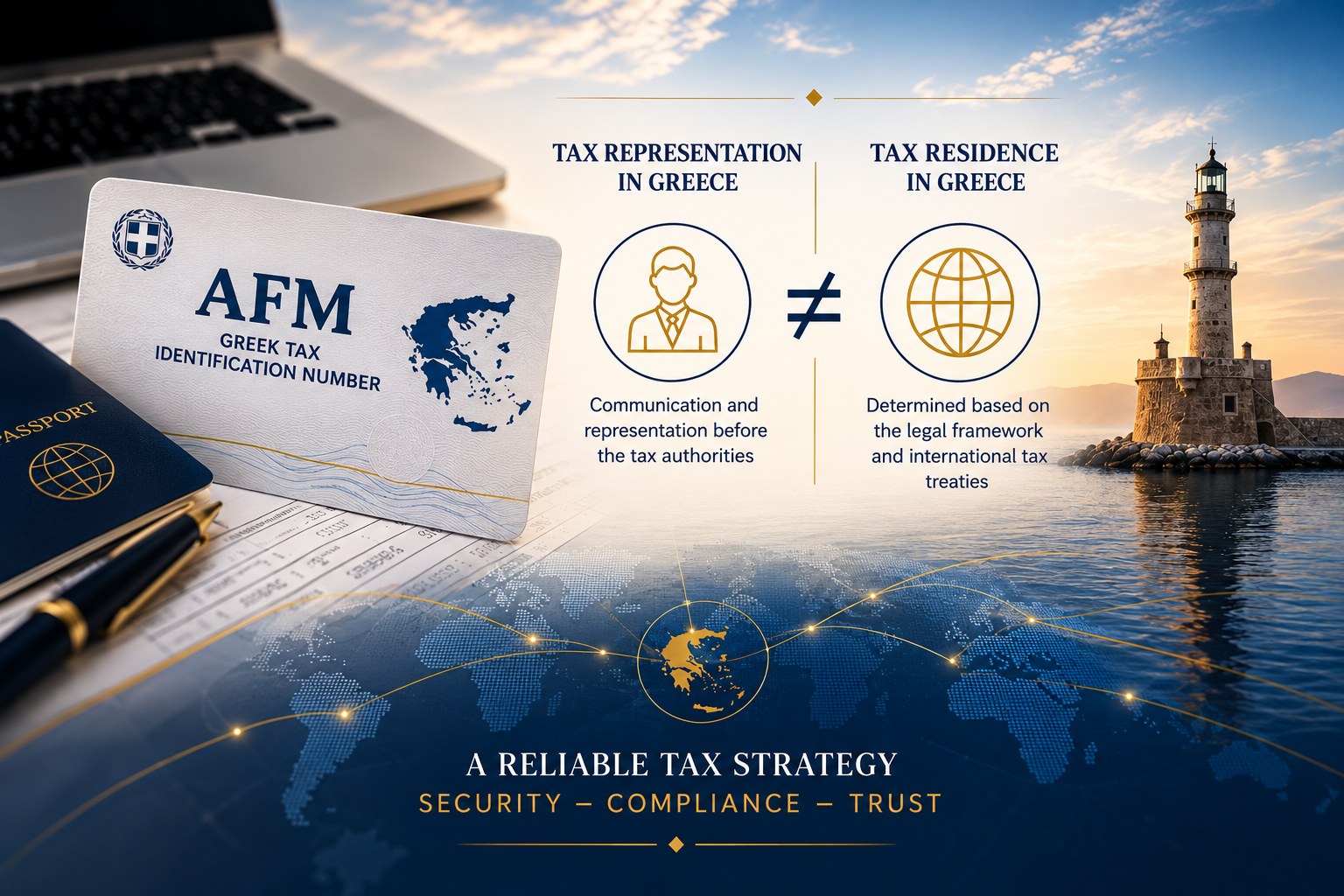
Obtaining a Greek Tax Identification Number (AFM) is a key step for foreign persons who intend to participate in establishing a company in Greece and are required to register with the Greek tax authorities.
To obtain an AFM, the prescribed information and supporting documents must be submitted to the Greek tax administration. For foreign applicants, correct identification and proper preparation of documents issued abroad are particularly important.
Where the applicant is outside Greece, the procedure may, subject to the applicable requirements, be completed through a duly authorised person in Greece. Thus, in many cases the foreign applicant does not need to be physically present solely to complete the relevant tax formalities.
Where a foreign legal entity is participating, the necessary tax formalities must likewise be completed in Greece, and the appropriate corporate and supporting legal documents of the foreign company must be provided.
Timely completion of the tax procedures is important, as it is directly linked to the subsequent stages of establishing and lawfully operating the company in Greece.
Tax Representative and Tax Residence
For persons who are tax residents abroad, the applicability of the rules on tax representation in Greece must be examined, depending on the circumstances and the procedure followed.
A tax representative acts as a point of contact between the non-resident taxpayer and the Greek tax administration in cases where such an appointment is required. The role is essentially procedural and does not mean that the representative automatically assumes the tax obligations or liability of the person represented.
It is particularly important to distinguish tax representation from tax residence. Appointing a tax representative in Greece does not, in itself, mean that the foreign person transfers their tax residence to Greece.
Tax residence is a separate matter and is determined according to the criteria laid down in Greek tax legislation. Where a person has tax connections with more than one country, the provisions of any applicable Double Taxation Agreement must also be examined.
Consequently, a foreign national may obtain an AFM, participate in a Greek company and, where required, have a tax representative in Greece, without any of these circumstances, in themselves, making that person a Greek tax resident.
This distinction is particularly important for foreign entrepreneurs and investors, as participation in a Greek company may give rise to specific tax obligations in Greece without necessarily changing their tax residence.