

 By Spanos Theodoros · · Updated
Letting a residential property provides many owners with a stable source of income. At the same time, however, it creates a contractual relationship that may last for years and affect both the financial return and the condition of the property.
A landlord’s protection does not begin when unpaid rent, damage or disagreements with the tenant arise. In fact, it begins before the keys are even handed over.
Careful tenant selection, a properly drafted lease agreement, documentation of the property’s condition upon handover, and prompt action when problems arise can significantly reduce the risk of future tenancy disputes.
Before the Tenancy: Selecting the Tenant
One of the first issues a landlord faces is assessing a prospective tenant.
It is reasonable for a landlord to want to know with whom they are about to enter into a contractual relationship lasting several years and to assess whether the prospective tenant genuinely has the means to pay the agreed rent.
However, this process must be conducted lawfully and proportionately. The collection of personal data must not be discriminated against; it must be limited to information for which there is a lawful basis for processing, and which is necessary for the intended purpose.
The objective, therefore, should not be to gather as much information as possible about the prospective tenant, but to carry out a sufficient and lawful assessment of the tenancy relationship about to be established.
The Lease Agreement Is Not a Mere Formality
A common mistake is to treat the lease agreement as a standard-form document in which it is sufficient simply to identify the property, the rent and the term.
A properly drafted lease agreement forms the fundamental framework governing the relationship between landlord and tenant.
Depending on the property and the parties’ needs, it is important to set out clearly:
- the precise permitted use of the property and the persons who will reside in it,
- when and how rent is to be paid and adjusted,
- the security deposit and its purpose,
- building service charges and other financial obligations,
- the allocation of responsibilities for repairs and maintenance,
- subletting or granting use of the property to others,
- substantial alterations or modifications to the property,
- the circumstances in which access to the property may be required,
- and the handover and return procedure at the end of the tenancy.
The electronic declaration of the tenancy to the Independent Authority for Public Revenue (AADE) does not replace the need for a detailed private lease agreement. AADE itself clarifies that the declaration of lease information is submitted for tax purposes and does not determine the relationship between landlord and tenant.
Handover of the Property: The First Critical Stage

Before handing over the keys, it is particularly useful to document the actual condition of the home.
A handover report may record the condition of the walls, floors, doors, windows and other fittings and installations; the furniture and electrical appliances supplied with the property; the number of keys; and the meter readings.
This record may also be accompanied by photographic documentation of the property’s condition.
This is not a formal prerequisite for a landlord to claim compensation at a later date. It is, however, particularly useful evidence if a dispute arises at the end of the tenancy about when and how damage occurred.
Security Deposit: What Should the Lease Agreement Actually Provide?
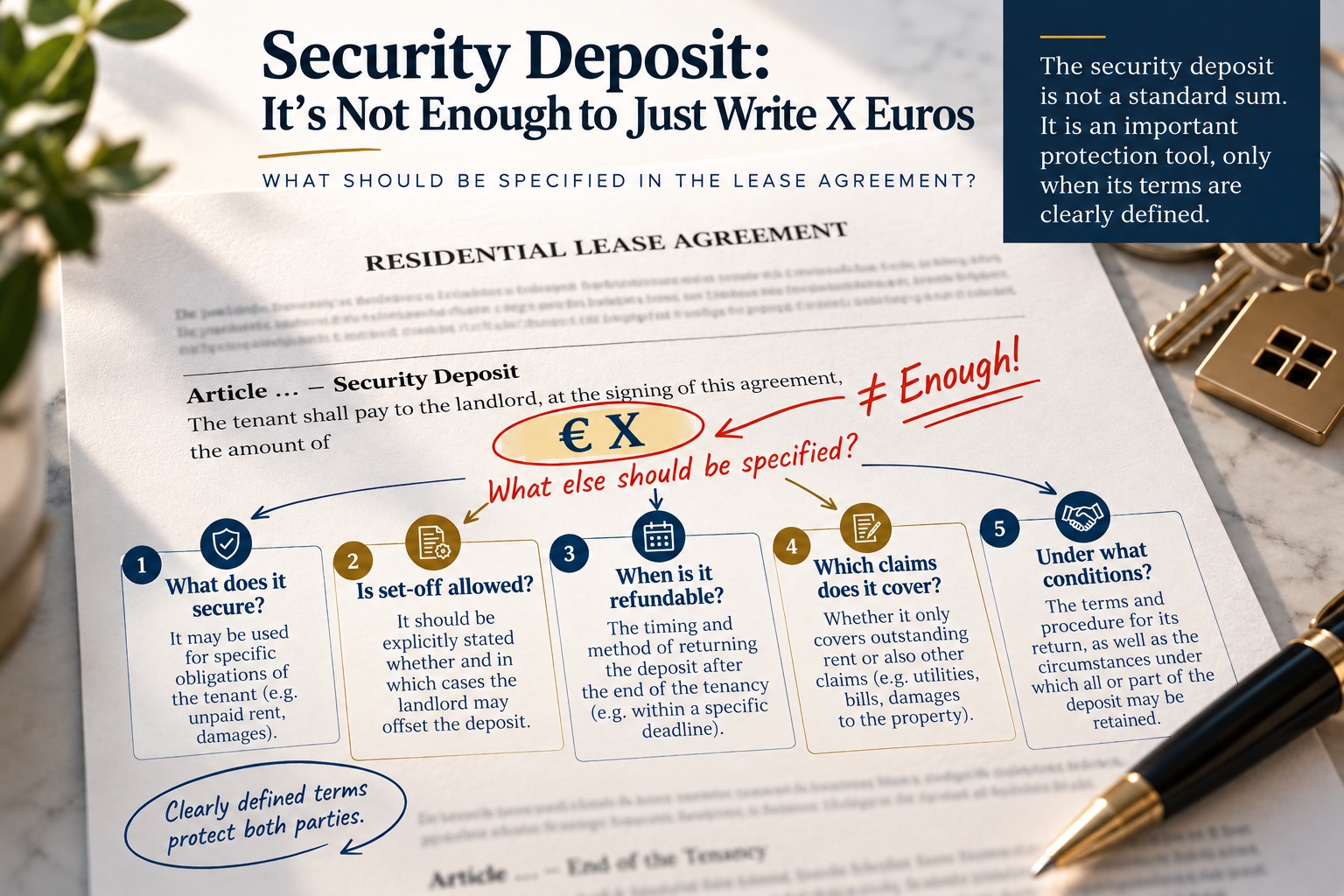
The amount commonly referred to as a “security deposit” should not be treated as a sum whose purpose is self-evident.
The legal function and treatment of the security deposit depend to a considerable extent on the agreement between the parties.
For this reason, the lease agreement should specify the amount paid, exactly what it secures, whether set-off is permitted and under what conditions, when the deposit becomes repayable, and which claims by the landlord may be covered by it.
A Real Example from Case Law
Piraeus Court of Appeal Decision 595/2024 concerned the letting of an apartment for residential use.
Under that agreement, a security deposit equal to one month’s rent had been agreed. The lease expressly provided that the amount would be returned after the tenant vacated on time and fulfilled her obligations, provided that the bills for which she was responsible had been paid and there was no damage to the property.
It had also been expressly agreed that the security deposit could not be set off against outstanding rent or the final month’s rent.
This example illustrates why it is so important not merely to state “security deposit: EUR X” in the agreement, but to define precisely the purpose of that amount.
Service Charges and Utility Bills: Clear Agreements Prevent Disputes
Building service charges and utility bills are a frequent source of disagreement both during a tenancy and when it ends.
The lease agreement should clearly specify which expenses are borne by the tenant and which by the landlord, taking account of the nature of each expense and the applicable legal framework.
The status of any outstanding charges when the property is returned is also particularly important. Being able to establish that the financial obligations for which the tenant was responsible have been settled can prevent subsequent disputes.
May the Landlord Enter the Rented Home?
The fact that a person remains the owner of the property does not mean that they have an unrestricted right to enter the home while its use has been granted to the tenant.
During the tenancy, there may be a genuine need for access, for example to carry out necessary works or address a specific problem.
For this reason, it is useful for the lease agreement to establish a reasonable framework for access, subject to prior arrangements and respect for the tenant’s lawful use of the property and privacy.
The landlord’s possession of a spare key should not be regarded as permission to enter the property freely.
What Should a Landlord Do as Soon as a Problem Arises?
Responding promptly is often more important than responding forcefully.
When a material breach of the lease, an outstanding financial obligation or a serious issue concerning the use of the property arises, the landlord should ensure that communications and the relevant facts can be proved if necessary.
This does not mean that every minor disagreement must immediately lead to a formal extrajudicial notice.
It does mean, however, that serious or repeated breaches should not be allowed to continue for long periods without being documented or addressed.
Where the problem persists or may lead to termination of the tenancy, it is important to assess promptly whether a formal extrajudicial step or another lawful procedure is required.
Does a Landlord Lose Their Rights by Tolerating a Breach?
Not necessarily.
In practice, a landlord may know that the tenant is breaching a term of the lease but not react immediately. For example, the landlord may be aware of a particular situation for a long time and tolerate it without asking the tenant to comply.
Such tolerance does not mean that the landlord loses the right to take action later.
However, the longer a situation continues without objection, the more significant the landlord’s previous conduct may become in a future dispute. If that conduct reasonably led the tenant to believe that the landlord accepted the situation and would not exercise the relevant right, the matter may require a different legal assessment.
Example
Suppose the lease prohibits a particular use of the property. For a long period, the landlord knows that the tenant is acting in breach of that term but raises no objection.
This does not automatically mean that the term ceases to apply. However, if the landlord later suddenly relies on the same breach, their prior knowledge and conduct may be considered alongside all the other circumstances of the case.
For this reason, when a landlord identifies a material breach of the lease, it is preferable to state their position promptly and clearly, so that there is no uncertainty as to whether they accept the situation.
Damage to the Property: What Must the Landlord Prove?
When the home is returned, a distinction must be made between normal wear and tear resulting from the agreed use and damage or alterations for which the tenant may be liable.
This distinction is of considerable practical importance.
It is not enough for the landlord to assert generally that “the property was returned damaged.” If seeking compensation, the landlord must identify and prove the specific damage or alterations and the amount of the loss suffered.
What Has the Supreme Court Ruled?
Greek Supreme Court (Areios Pagos) Decision 1226/2024 confirms that, when claiming compensation for damage or alterations caused during the tenancy, the landlord must plead and prove the specific damage and the amount of the loss.
Of particular interest is that, according to the same decision, the landlord is not also required to prove the condition of the property at the start of the tenancy. The tenant, for their part, may argue that the deterioration resulted from the agreed use or from another event for which they are not responsible.
Case law also recognises that, where the necessary causal link is established, compensation may include not only the cost of repairs but also further loss, such as lost rental income if the damage prevents the property from being let.
This demonstrates why photographic records and a handover report are so useful in practice: they are not prerequisites for bringing a claim, but they can significantly strengthen the evidence of the relevant facts.
The Return of the Property Should Be Properly Organised
As the time approaches for the home to be returned, it is useful for the landlord to organise the handover rather than merely collect the keys.
At handover, the condition of the property and its equipment, the keys returned, meter readings, any outstanding financial obligations and any visible damage can all be recorded.
Ideally, the final record can be compared with the corresponding record made at the beginning of the tenancy.
This makes it easier to determine what constitutes normal wear and tear, whether there is actual damage, and which financial matters must be settled before the tenancy accounts are finally reconciled and the security deposit is returned in accordance with the agreed terms.
What If the Landlord Wants to Sell the Rented Property?
The existence of an ongoing tenancy does not prevent the sale of the property.
However, it should not be assumed that a sale automatically terminates the tenancy.
Before the transfer, the existing lease agreement, its duration and form, and any special provisions concerning the transfer of the property should be examined.
Under Article 614 of the Greek Civil Code, where a lease of immovable property is evidenced by a document bearing a legally certified date, the new owner generally succeeds to the rights and obligations arising under the lease, unless otherwise agreed in the lease agreement.
Selling a rented property therefore requires an examination of the particular tenancy before completion of the transfer, so that both seller and buyer understand whether, and on what terms, the existing lease will continue.
The Most Common Mistakes Landlords Should Avoid

In practice, many problems arise not only from the tenant’s conduct but also from inadequate preparation of the tenancy itself.
Particularly problematic practices include:
- using an excessively generic lease agreement,
- handing over the property without recording its condition,
- failing to define the security deposit clearly,
- failing to agree clearly on financial obligations, and
- remaining inactive for a prolonged period in the face of significant breaches.
It is equally mistaken to assume that, because the landlord remains the owner, they may enter the property whenever they wish or personally remove the tenant when a dispute arises.
Ownership of the property and protection of the landlord’s rights do not override the lawful use granted to the tenant or the procedures prescribed by law.
Prevention Is the Landlord’s Best Protection
Effective protection of a landlord does not depend solely on the steps taken once a tenancy has already developed into a legal dispute.
It begins much earlier.
A carefully drafted lease agreement, documentation of the home’s condition, clear provisions governing the security deposit and financial obligations, retention of appropriate evidence, and prompt action in response to material breaches can significantly reduce risk.
The aim is not to create an excessively rigid relationship between landlord and tenant. It is to establish a clear and workable contractual framework so that both parties know their rights and obligations from the outset.
Legal Support for Property Owners
SF Legal provides comprehensive legal support to property owners and investors at every stage of a long-term residential tenancy.
Our services may include drafting and reviewing lease agreements, developing tailored contractual clauses, assessing issues arising during the tenancy, preparing formal extrajudicial notices, resolving financial and other tenancy disputes, and providing legal assistance with the handover and return of the property.
Early legal preparation can protect the property more effectively and significantly reduce both financial risk and the likelihood of a future tenancy dispute.