

 By Spanos Theodoros · · Updated
A prospective tenant will usually assume that the person letting a property to them must also be its owner.
From a legal perspective, however, this is not always necessary.
Under Greek law, a lease agreement may, in principle, be valid even if the landlord does not own the property.
Why Can Such a Lease Be Valid?
Under Article 574 of the Greek Civil Code, a lease agreement obliges the landlord to grant the tenant the use of the property for the duration of the agreement, while the tenant undertakes to pay the agreed rent.
A lease creates a contractual obligation rather than a right-in-rem. Consequently, ownership of the property is not, as a rule, a necessary condition for the validity of the agreement.
This position has repeatedly been confirmed by the Greek Supreme Court (Areios Pagos), which has held that a lease may be valid even where the property is not owned by the landlord.
Does This Mean That Anyone Can Let Someone Else’s Property?
Not exactly. This is where the most important distinction lies.
The fact that a lease of property belonging to another person may be valid between the landlord and the tenant does not mean that the rights of the actual owner are automatically restricted.
The actual owner of the property, insofar as they are not bound by the lease, retains the rights arising from ownership or possession.
We must therefore distinguish between two separate issues:
Whether the lease agreement is valid between the landlord and the tenant is one question; whether that lease binds the actual owner of the property is another.
When Might the Landlord Not Be the Owner?

There are several circumstances in which the person granting use of the property is not its full owner.
For example, that person may be a usufructuary or someone acting on behalf of the owner under appropriate authorisation or a power of attorney.
Subletting is another situation. Under Article 593 of the Greek Civil Code, a tenant is, in principle, entitled, unless otherwise agreed, to grant a third party the use of the leased property, particularly by subletting it.
Therefore, the mere fact that the person acting as landlord does not own the property does not make the lease invalid or unlawful.
Where Does the Risk for the Tenant Lie?
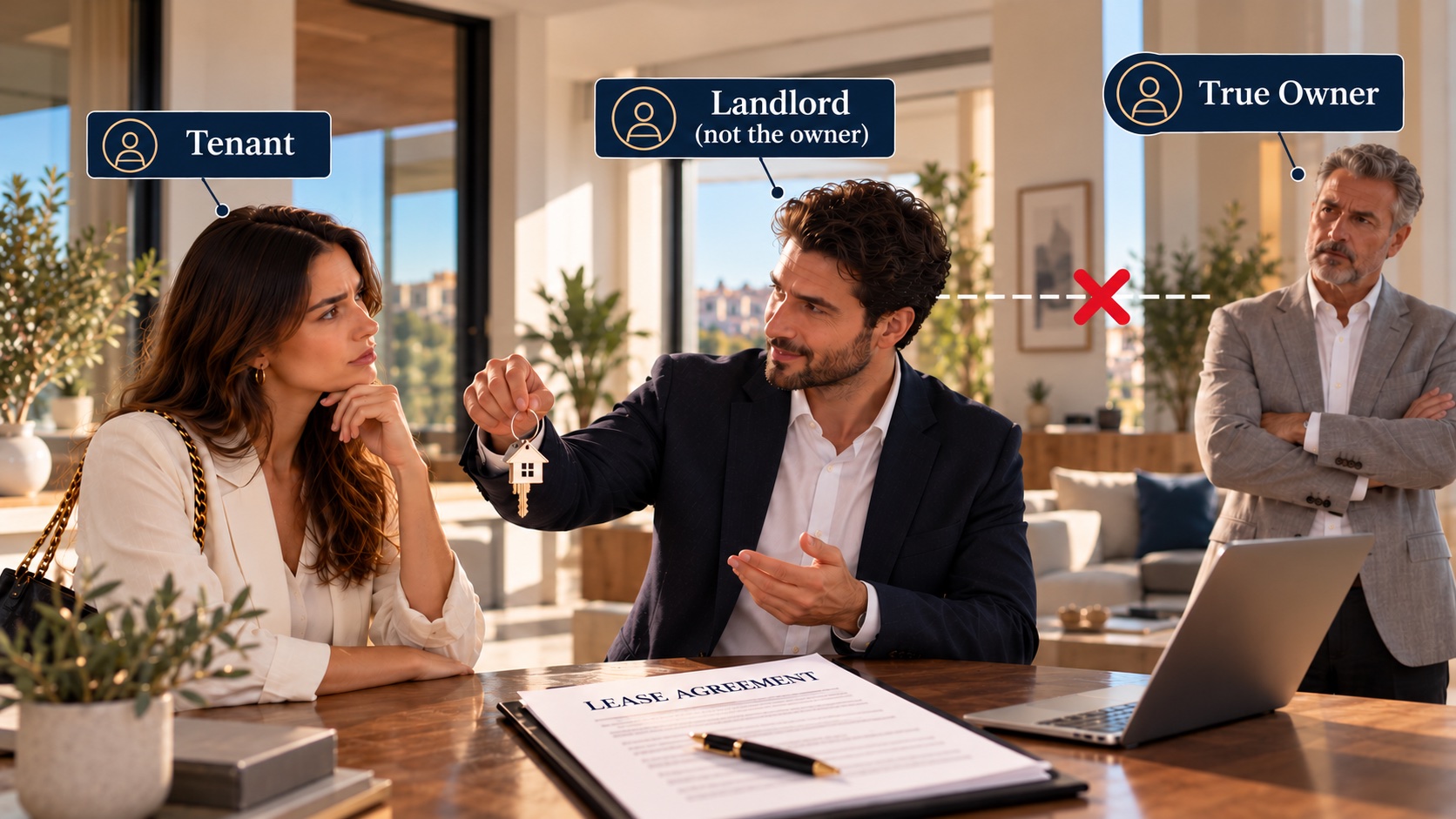
The problem arises when someone lets property belonging to a third party and the actual owner is not bound by that lease.
The Greek Supreme Court has clarified that, even where a lease of property belonging to another person is valid between the landlord and the tenant, it does not prejudice the actual owner’s rights arising from ownership or possession.
The owner may therefore, where the legal requirements are met, exercise their own rights to protect the property and recover its possession.
For the tenant, it is therefore not enough simply to know that the lease they signed may be valid. It is important to establish the legal capacity in which the person acting as landlord grants them the use of the particular property.
What Should the Tenant Check Before Signing?

Before entering a lease, it is advisable to establish who owns the property and in what capacity the person acting as landlord is doing so.
If that person is not the owner, the legal basis on which they grant use of the property should be examined: for example, whether they are a usufructuary, act as the owner’s authorised representative, or are subletting the property.
This verification is particularly important before paying substantial sums such as a security deposit, an advance payment or rent paid in advance.
The Greek Supreme Court has repeatedly held that a lease may be valid even if the leased property is not owned by the landlord, because a lease establishes a contractual obligation rather than a right in rem.
At the same time, however, it has clarified that a lease of property belonging to another person does not prejudice the rights of the actual owner over that property.
Accordingly, the right question to ask before signing a lease is not merely:
“Is the landlord the owner?”
but, more importantly:
“If the landlord is not the owner, in what legal capacity are they granting me use of the property, and is the actual owner bound by this lease?”
Conclusion
Yes, it is possible to enter into a valid lease agreement with someone who does not own the property.
However, this does not mean that anyone can let property belonging to a third party without consequences, or that the actual owner is automatically bound by such an agreement.
For the tenant, the crucial issue is to verify not only who signs as landlord, but also the legal capacity in which that person grants use of the property and whether the lease is enforceable against the actual owner.
Where there is uncertainty regarding ownership, usufruct, representation or subletting, conducting legal due diligence before signing the lease and paying any money can prevent a significant dispute in the future.