

 By Spanos Theodoros ·
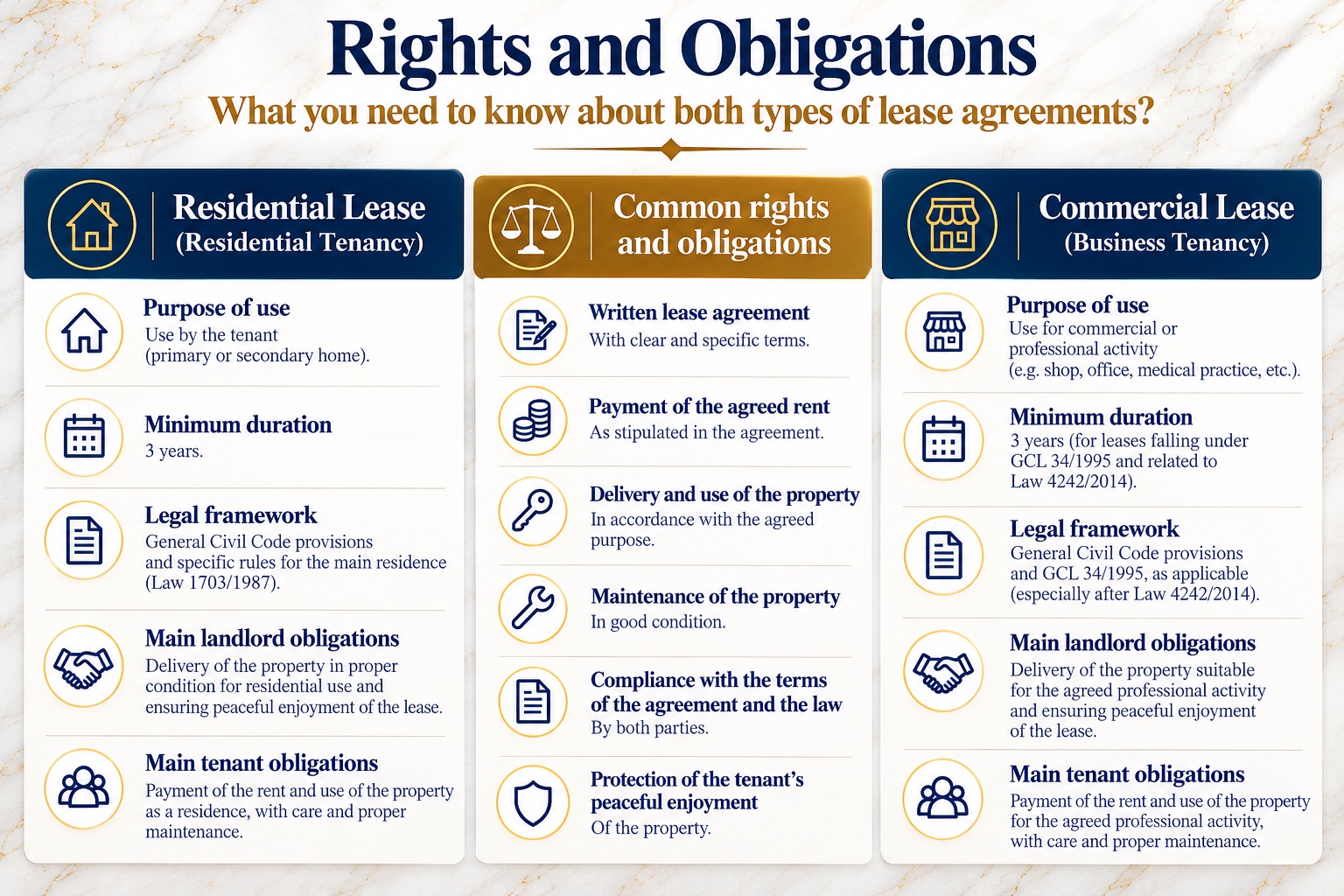
When a property is leased, one of the first matters to establish is the purpose for which its use is being granted.
An apartment leased for residential use is different from premises leased for the operation of a shop, office, medical practice or another professional activity.
In everyday practice, the terms “civil” and “commercial” lease are often used. In this article, the term “civil lease” refers specifically to a residential lease, so that we can examine its main differences from a commercial lease.
The distinction is not merely terminological. It affects the applicable legal framework, the duration of the lease, the significance of contractual terms, and a number of practical and financial matters that both landlords and tenants should understand.
What Is a Residential Lease and How Long Does It Last?
A residential lease arises when a property is made available for the purpose of housing the tenant.
The most typical example is the long-term lease of an apartment in which the tenant takes up residence and lives.
The concept of a primary residence is particularly important, as Law 1703/1987 establishes a special regime for leases of properties used, under the lease agreement, as the tenant’s primary residence.
One of the most important features of a primary-residence lease is the statutory minimum term of three years.
The lease remains in force for at least three years, even if a shorter term or an indefinite duration has been agreed.
For example, if a landlord and tenant sign a one-year lease for a primary residence, that agreement does not mean that the landlord may disregard the statutory three-year minimum merely because the first year has elapsed.
Conversely, if a longer term has been agreed, such as five years, that longer contractual term is, in principle, binding on the parties.
The statutory three-year period may be shortened only by a subsequent agreement concluded at least six months after the commencement of the lease and evidenced by a notarial instrument.
What Is a Commercial Lease and How Long Does It Last?
Under a commercial lease, a property is made available for the conduct of a professional or commercial activity falling within the relevant statutory regime.
Typical examples include leasing premises for the operation of:
- a shop,
- a law firm or accounting office,
- a medical practice,
- a pharmacy,
- an educational establishment,
- a workshop or laboratory,
- or another professional or commercial activity.
Commercial leases falling within the relevant scope of application are currently governed by their contractual terms, the general provisions of the Greek Civil Code and those provisions of Presidential Decree 34/1995 that remain applicable, as this framework was shaped by Law 4242/2014.
Here, too, a three-year period applies, but on a different legal basis.
Commercial leases falling within Presidential Decree 34/1995 and concluded after the entry into force of Law 4242/2014 remain valid for at least three years, even where a shorter term or an indefinite duration has been agreed.
However, if the parties agree from the outset on a longer term, such as five, six or nine years, the lease is not automatically limited to three years. Three years is a minimum, not a maximum, term.
Accordingly, the fact that both primary-residence leases and modern commercial leases have a minimum three-year term does not mean that they are governed by the same legal regime.
The Main Difference Is the Use of the Property
To determine which regime applies, it is not always sufficient simply to consider the physical form of the property. The agreed use is particularly important.
An apartment may be leased as a residence, while premises may, subject to the appropriate factual and legal requirements, be used for professional purposes.
For this reason, the lease agreement should clearly specify the use for which the property is being made available. The agreed use is relevant not only to the legal classification of the lease but also to the tenant’s obligations throughout its term.
What Happens When a Property Is Used Both as a Residence and as Business Premises?
In practice, mixed-use situations also arise. For example, a professional may use part of an apartment as a residence and another part as a workspace. In such cases, it is particularly important to determine which use is predominant.
Law 1703/1987 expressly provides that, where mixed use has been agreed, the special regime governing primary residences applies if use of the leased property as a primary residence is predominant.
Consequently, in a genuine mixed-use case, it is not enough simply to label the agreement “residential” or “commercial”. The parties’ agreement and the actual characteristics of the use must be examined.
Can the Tenant Change the Use of the Property?
No. The tenant must use the property in accordance with the purpose for which it was leased.
For example, where a property has been leased exclusively as a residence, the tenant should not assume that it may automatically be converted into premises for carrying out any professional activity.
Similarly, in a commercial lease, it is necessary to establish whether the activity is permitted at the property and whether any special licences, approvals or other requirements apply.
Before entering a commercial lease, it is therefore particularly important to verify that the property can, both legally and in practice, accommodate its intended activity.
Why Does a Commercial Lease Agreement Require Particular Attention?
In a commercial lease, the property may form an essential part of the tenant’s business operations.
A shop may involve substantial fit-out costs, equipment, an established customer base and a particular commercial location. A medical practice, office or other professional premises may require specialised installations or adaptations.
For this reason, matters of particular importance in a commercial lease agreement include:
- the duration of the lease,
- the amount of rent and its adjustment,
- the precise permitted business use,
- works and alterations to the premises,
- licences required for the activity,
- allocation of repair and other costs,
- installation of signage or professional equipment,
- subletting or granting use to third parties,
- conditions for early termination,
- and the condition in which the property must be returned.
A general or standard-form lease agreement may therefore prove inadequate for a complex commercial relationship.
What Rules Apply to Rent Adjustments?
Rent is a fundamental contractual term in both categories of lease.
In commercial leases, however, account must also be taken of any specific legislative measures in force at the relevant time.
For 2026, legislation provides that, for commercial property leases falling within the scope of Presidential Decree 34/1995, the maximum rent adjustment is 3% of the rent payable in 2025, for the period from 1 January to 31 December 2026.
This measure has a defined scope of application and is subject to statutory exceptions. Accordingly, before adjusting the rent under a commercial lease, it is necessary to establish whether that particular lease is in fact subject to the restriction.
Is There a Tax Difference Between Residential and Commercial Leases?
Yes, there may be a significant difference. Subject to the statutory conditions, leases of immovable property for the conduct of professional activity are subject to Digital Transaction Duty at a rate of 3.60% of the agreed rent, provided that the lease has not been brought within the VAT regime under the relevant tax legislation.
By contrast, Digital Transaction Duty does not apply to residential leases.
The tax treatment should therefore be considered before entering a commercial lease, as it may affect the overall financial cost of the transaction.
What Rules Apply to Repairs and Alterations?
In both categories, the general rules of the Greek Civil Code apply regarding the landlord’s obligation to deliver the leased property in a condition suitable for the agreed use and to maintain it in such a condition throughout the lease.
In commercial leases, however, the issue is often more complex. The tenant may need to carry out fit-out works, install professional equipment or adapt the premises to the needs of its business. The lease agreement should therefore specify which alterations are permitted, whether the landlord’s prior consent is required, who bears the costs, and what will happen to installations or modifications when the lease ends.
What Happens When the Lease Ends?
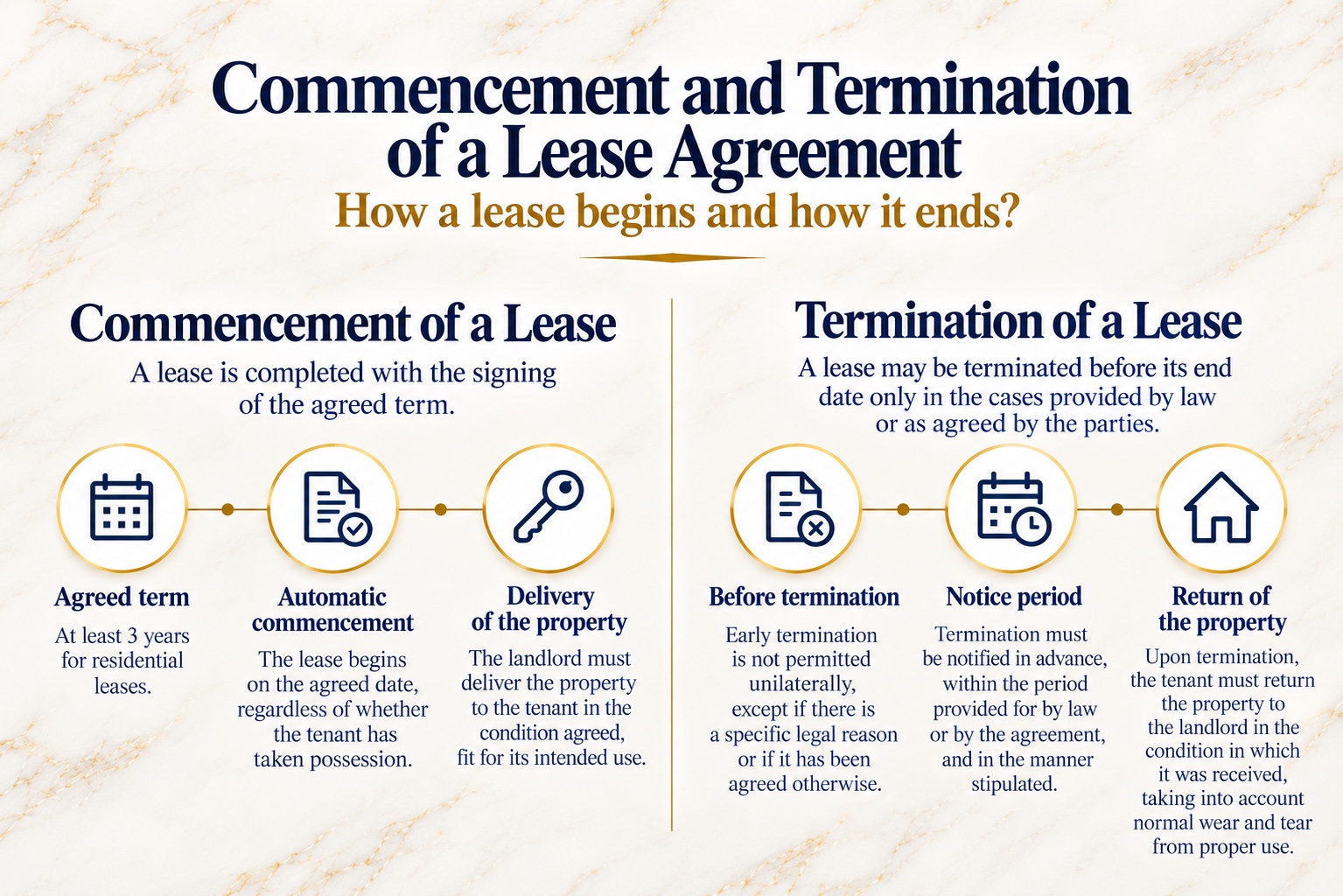
Expiry and termination should not be treated in the same way for every lease.
The type of lease, its agreed duration, the terms of the lease agreement and the applicable special provisions must all be considered.
Care is required with commercial leases because the applicable regime also varies according to when the agreement was concluded. Older commercial leases should not automatically be treated under the same rules as those concluded after Law 4242/2014 entered into force.
The Key Differences in Simple Terms
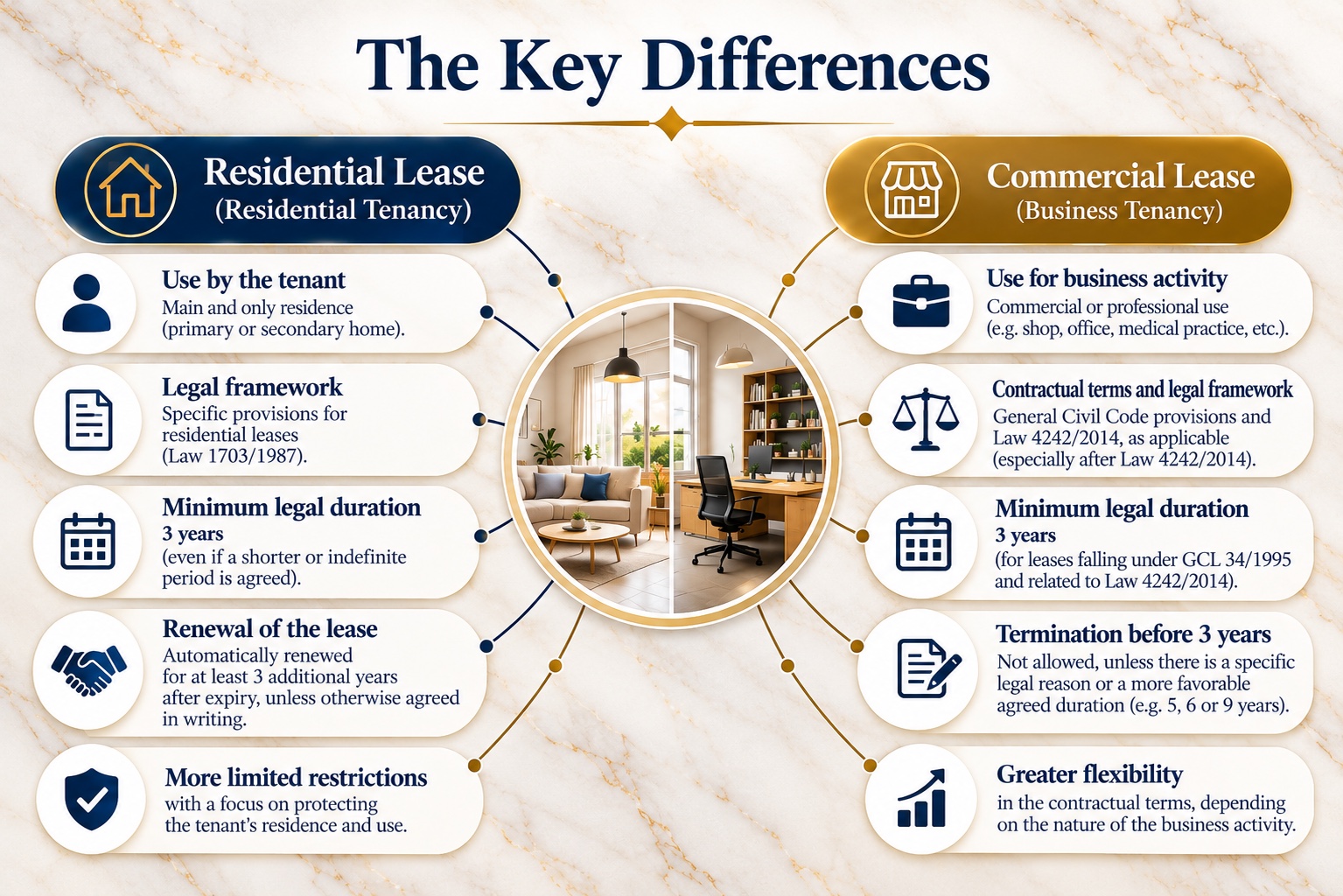
A residential lease is intended to provide housing for the tenant and, where the property is used as a primary residence, is subject to a statutory minimum term of three years.
A commercial lease concerns the use of a property for professional or commercial activity falling within the relevant statutory regime. More recent commercial leases governed by Presidential Decree 34/1995 are likewise subject to a minimum three-year term.
Despite this shared three-year minimum, the two regimes are not identical. They differ in their legal basis, intended use, significance of specific contractual provisions, and certain financial and tax matters. In addition, under a commercial lease, the suitability of the premises for the particular business activity and the precise regulation of works, permits and investments to be undertaken at the property are especially important.
Why Is It Important to Identify the Type of Lease from the Outset?
Correctly classifying a lease is not merely a theoretical legal matter. It determines which rules apply and how the lease agreement should be structured.
Before signing, the following matters should be clear:
the permitted use, the duration, the financial terms, the alterations permitted at the property, and the legal regime applicable to the lease.
Especially in commercial leases, where the tenant may invest substantial sums in the premises and the owner may commit the property for a long period, properly drafting the terms before signature can prevent significant disputes in the future.
Legal Support for Property Leases
SF Legal provides legal support to property owners, tenants, investors and businesses in relation to residential and commercial property leases.
Legal support may include assessing the applicable lease regime, drafting or reviewing the lease agreement, tailoring specific provisions to the intended use of the property, and resolving disputes that may arise during the lease or upon its expiry.
Proper legal preparation before signing can protect both the value and use of the property and the financial and business interests of the contracting parties.