
 By Spanos Theodoros ·
Choosing the appropriate legal form is one of the most important decisions when establishing a business in Greece. A company’s legal form is not merely a formal characteristic; it materially affects matters such as the liability of partners or shareholders, the company’s management and representation, ownership interests, the ability to admit new investors and, more generally, the future operation and growth of the business.
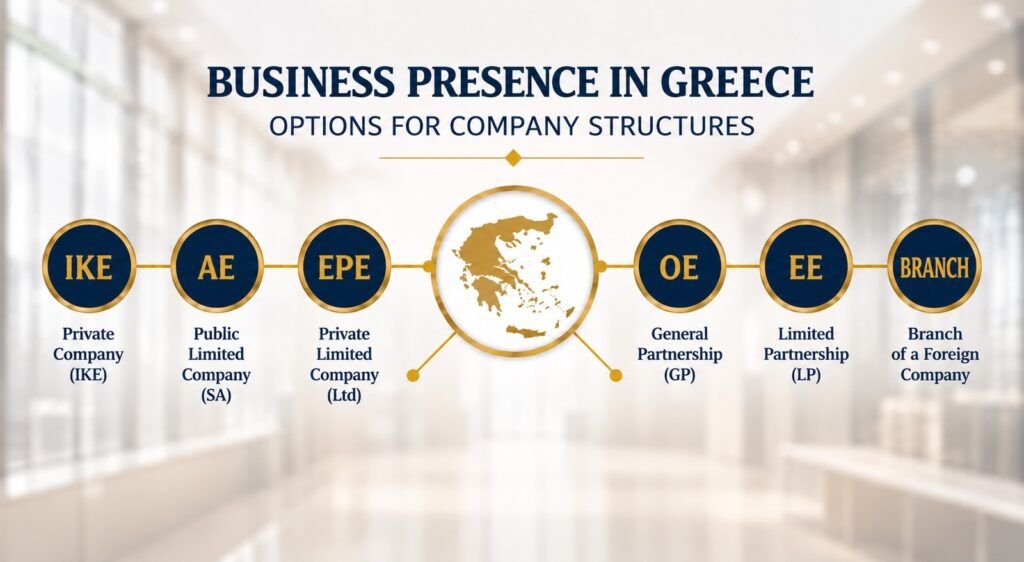
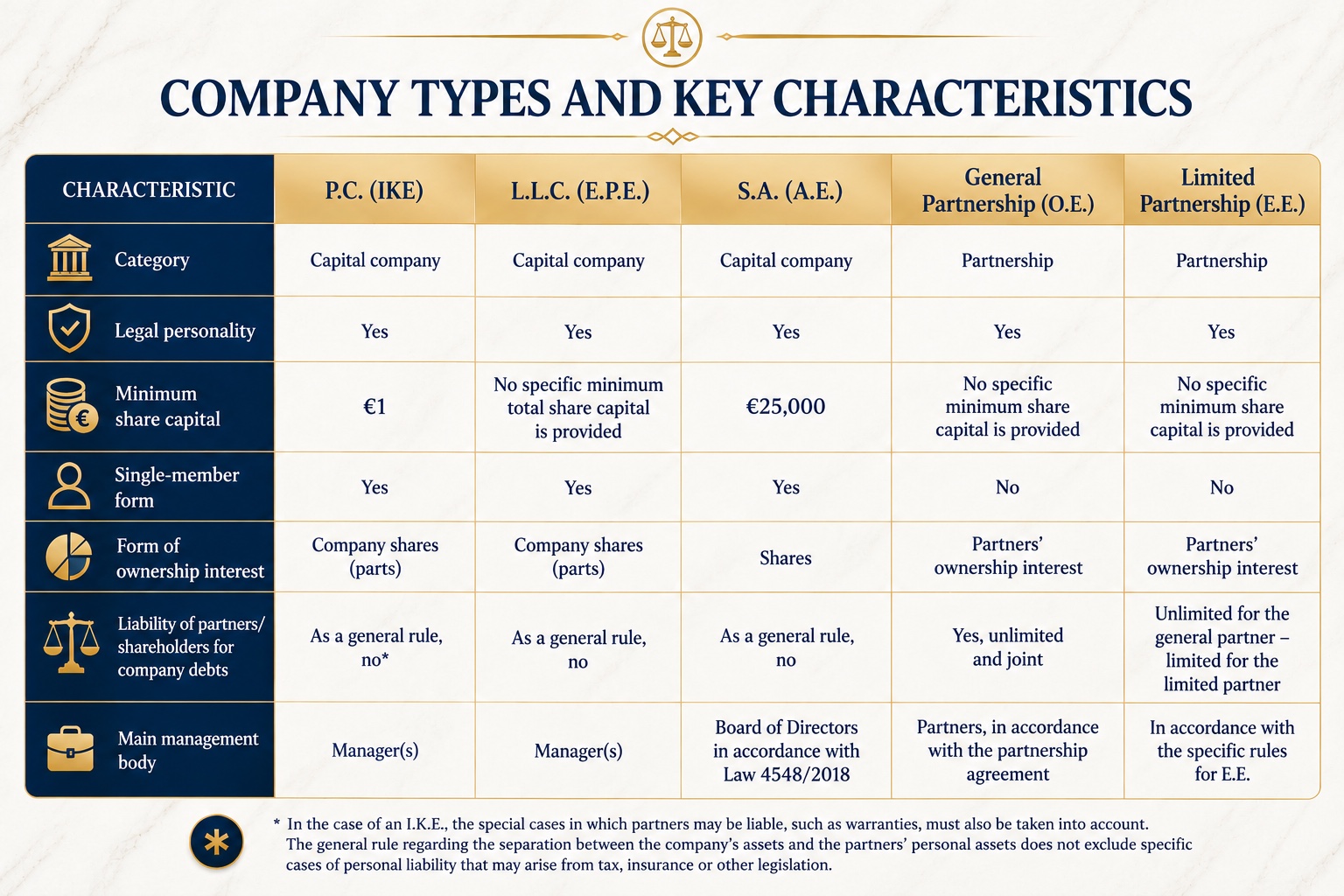
The principal company types encountered in Greek business practice include the Private Company (I.K.E.), the Limited Liability Company (E.P.E.), the Société Anonyme (A.E.), the General Partnership (O.E.) and the Limited Partnership (E.E.).
Each company type has distinct characteristics. Accordingly, the choice should follow an assessment of the actual needs of the particular business activity.
1. Private Company – I.K.E.
The Private Company is a capital company with separate legal personality.
Its key characteristic is that, subject to the specific exceptions provided by law, only the company itself is liable for its corporate obligations, to the extent of its own assets.
The capital of an I.K.E. may be as little as one (1) euro. This exceptionally low minimum capital does not, of course, mean that one euro is sufficient in practice for every business. The capital actually required must be assessed in accordance with the company’s activities and financing needs.
An I.K.E. may also be established by a single person, in which case it is a single-member I.K.E.
A distinctive feature is that partners’ contributions are not limited to capital contributions. The legislation governing I.K.E.s also provides for non-capital contributions and guarantee contributions, allowing greater flexibility in adapting the corporate structure to the arrangements agreed between the partners.
For this reason, the I.K.E. offers considerable flexibility in designing the company’s internal operations. This, however, makes the careful drafting of its articles of association all the more important, particularly where there is more than one partner.
2. Limited Liability Company – E.P.E.
The Limited Liability Company is a capital company.
The partners’ ownership interests are represented by company units, and the E.P.E. has separate legal personality.
Importantly, there is currently no prescribed minimum aggregate company capital for establishing an E.P.E. The amount of capital is determined by the partners, subject to the rules governing company units.
An E.P.E. may also exist as a single-member E.P.E. where all company units are held by one person.
Although the I.K.E. has introduced a newer and particularly flexible capital-company form into Greek company law, the E.P.E. remains a distinct and fully available corporate option. It should therefore not be ruled out in advance but assessed in relation to the specific corporate structure sought.
3. Société Anonyme – A.E.
The Société Anonyme is a capital company with separate legal personality.
Its capital is divided into shares, which is one of its most significant differences from the I.K.E. and E.P.E.
The minimum share capital of an A.E. is currently EUR 25,000 and must be fully deposited upon incorporation.
An A.E. may be established by one or more persons and may therefore also operate as a single-shareholder company.
Its corporate organisation is more formally regulated and includes, among other bodies, the General Meeting of Shareholders and the company’s management body.
The A.E. provides a particularly detailed statutory framework governing the company’s operation, shares, corporate decisions and relations between the company and its shareholders. It may therefore be considered where the business plan calls for a more complex shareholding or management structure.
This does not mean that the A.E. is legally reserved exclusively for “large businesses”. Its suitability depends on the characteristics of the particular investment.
4. General Partnership – O.E.
The General Partnership is a partnership and differs fundamentally from the capital companies examined above.
Its most important characteristic concerns the liability of its partners: general partners are jointly and severally liable, without limitation, for the partnership’s debts.
This is a critical legal characteristic because operating through an O.E. exposes a partner to a different degree of personal liability from that generally borne by a member of a capital company.
An O.E. does not require the same formal capital and organisational structure as an A.E.; however, the advantage of simpler corporate organisation must always be weighed against the partners’ personal liability regime.
Therefore, before choosing an O.E., consideration should be given not only to its operational simplicity but, above all, to the financial and legal risks associated with the activity.
5. Limited Partnership – E.E.
The Limited Partnership is also a partnership but has a distinctive structure regarding partners’ liability.
An E.E. must have at least one general partner, who has unlimited liability for the partnership’s debts, and at least one limited partner, whose liability is governed by different rules.
More specifically, where a limited partner has paid their contribution, they are generally not liable for the partnership’s debts. If they have not paid their contribution, they are personally liable up to the amount of that contribution. The law also provides for specific circumstances in which a limited partner’s position may affect the extent of their liability.
A characteristic example is the inclusion of a limited partner’s name in the partnership’s business name, which may, under the conditions laid down by law, result in unlimited liability towards third parties.
Accordingly, in an E.E., particular care is required in determining each partner’s status, drafting the articles of association and establishing how the partnership is represented.
Which Company Type Should Be Chosen?
No single company type is objectively “better” than all the others.
The choice should be the result of tailored legal and business planning.
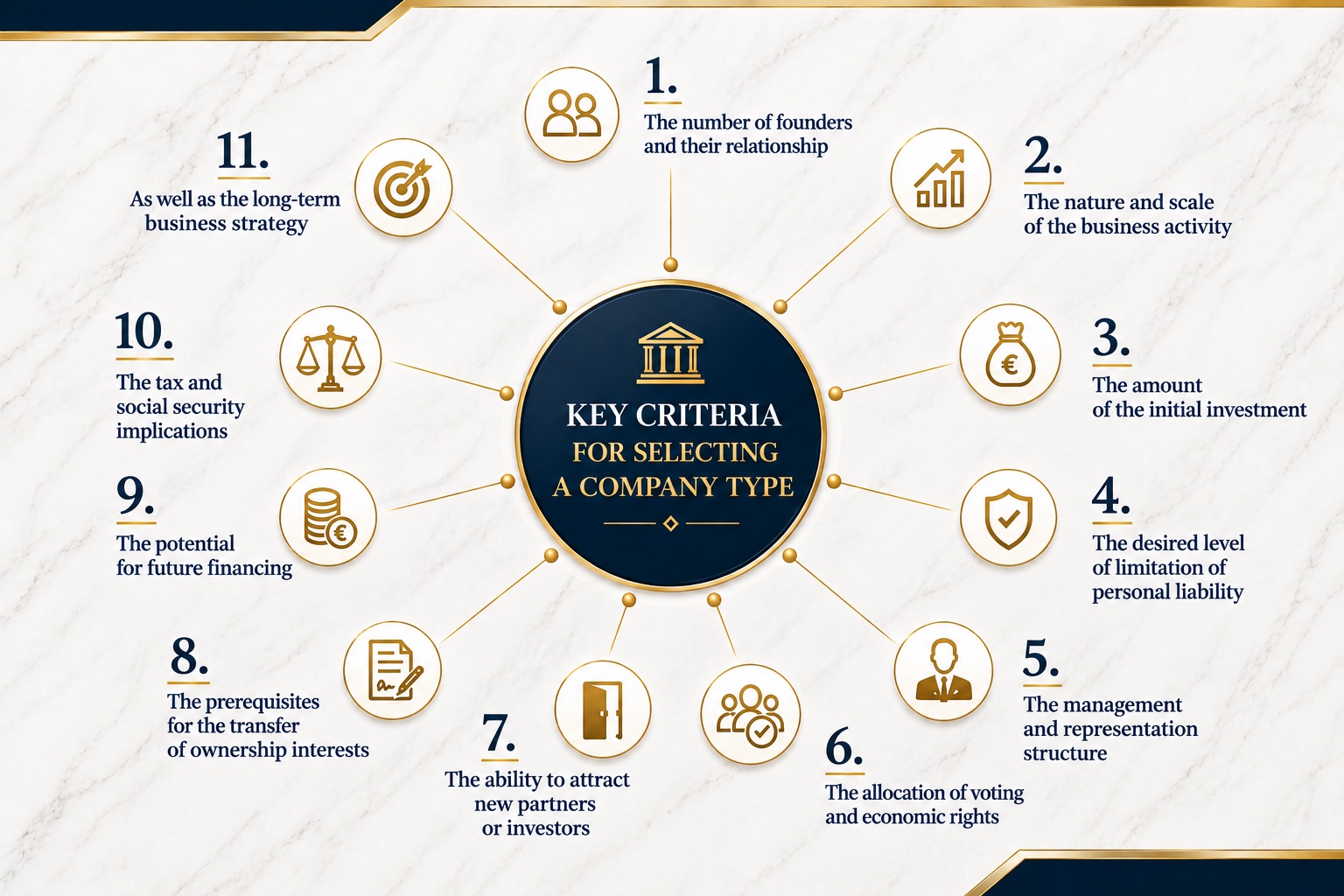
Before establishing a company, the following matters should be considered in particular:
- the number of founders and their relationship to one another;
- the nature and scale of the business activity;
- the amount of the initial investment;
- the desired extent of limitation of personal liability;
- the method of management and representation;
- the allocation of voting rights and economic rights;
- the possibility of admitting new partners or investors;
- the conditions for transferring ownership interests;
- the possibility of future financing;
- the tax and social security implications;
- and the long-term business plan.
The company’s articles of association are also of particular importance. Choosing the right company type is only the first stage. Where legally permissible, the articles of association should be tailored to the actual needs of the partners or shareholders and should clearly address matters that may cause difficulties in the future, such as management, decision-making, transfers of ownership interests, admission of new investors and withdrawal of a partner.
Company Incorporation and the General Commercial Registry (G.E.MI.)
Companies in Greece are incorporated through the One-Stop Shop (Y.M.S.) framework.
LEGAL NOTE
The I.K.E., E.P.E., A.E., O.E. and E.E. are not simply different names for the same business structure. They differ materially in terms of capital, participants’ liability, management, ownership interests and internal organisation.
For this reason, the choice should not be based solely on the cost or speed of incorporation, or on which company type is most used in the market.
The appropriate company type is the one that meets the needs of the particular business activity, the relationship between partners or investors, the acceptable level of business risk and the company’s future growth plans.
Before incorporation, assessing the company type together with the proper drafting of the articles of association can prevent significant legal and operational difficulties and provide a more secure foundation for the company’s future growth.
SF Legal Law Firm
SF Legal provides legal support to individuals and businesses in the planning, establishment and legal structuring of companies, as well as in the review and negotiation of Articles of Association for all types of companies.
Choosing the appropriate legal form and drafting well-structured Articles of Association are essential foundations for secure and efficient business operations.