
 By Spanos Theodoros ·
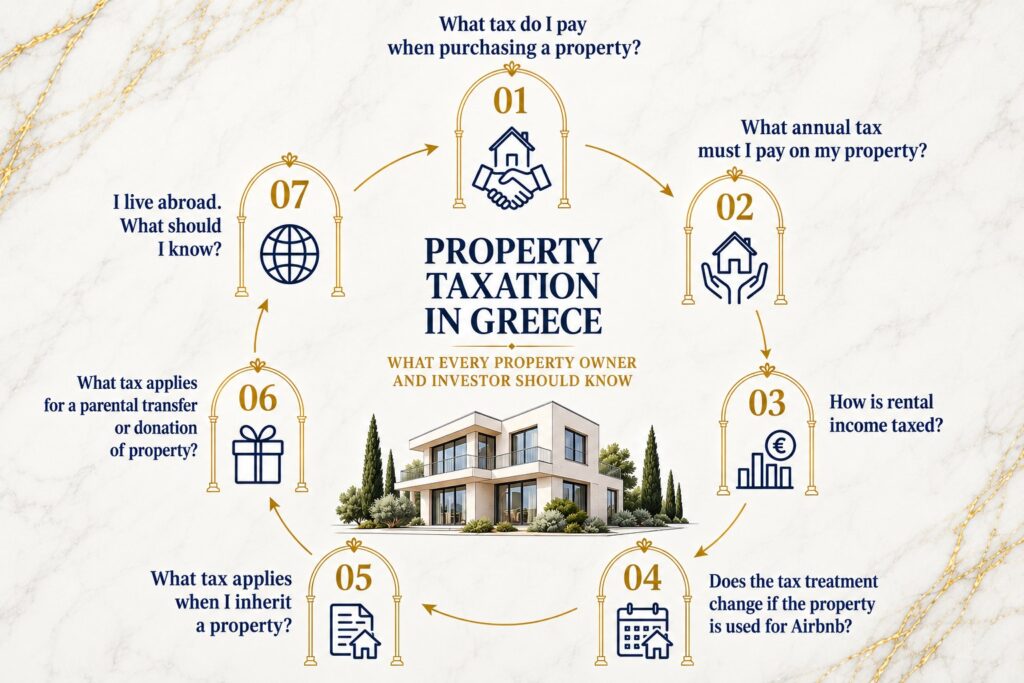
Purchasing and owning property in Greece involves specific tax obligations. Different taxes may arise from the purchase, ownership, exploitation, donation, parental transfer, or inheritance of real estate.
For property owners, particularly investors and individuals residing abroad, it is essential to understand not only which taxes apply, but also when each tax obligation arises and how the chosen method of acquiring and exploiting a property may affect the overall tax burden.
What taxes do I pay when purchasing property in Greece?
When purchasing property, the buyer is generally required to pay Real Estate Transfer Tax (RETT) before signing the final deed of sale.
The standard Real Estate Transfer Tax rate is 3% of the property’s taxable value.
An additional levy in favour of municipalities and communities, equal to 3% of the principal transfer tax, is also imposed. Consequently, the total tax burden effectively amounts to approximately 3.09% of the property’s taxable value.
In certain circumstances, an exemption from Real Estate Transfer Tax may apply, such as when purchasing a primary residence for the first time, provided that the statutory requirements are met.
What annual tax must I pay on my property?
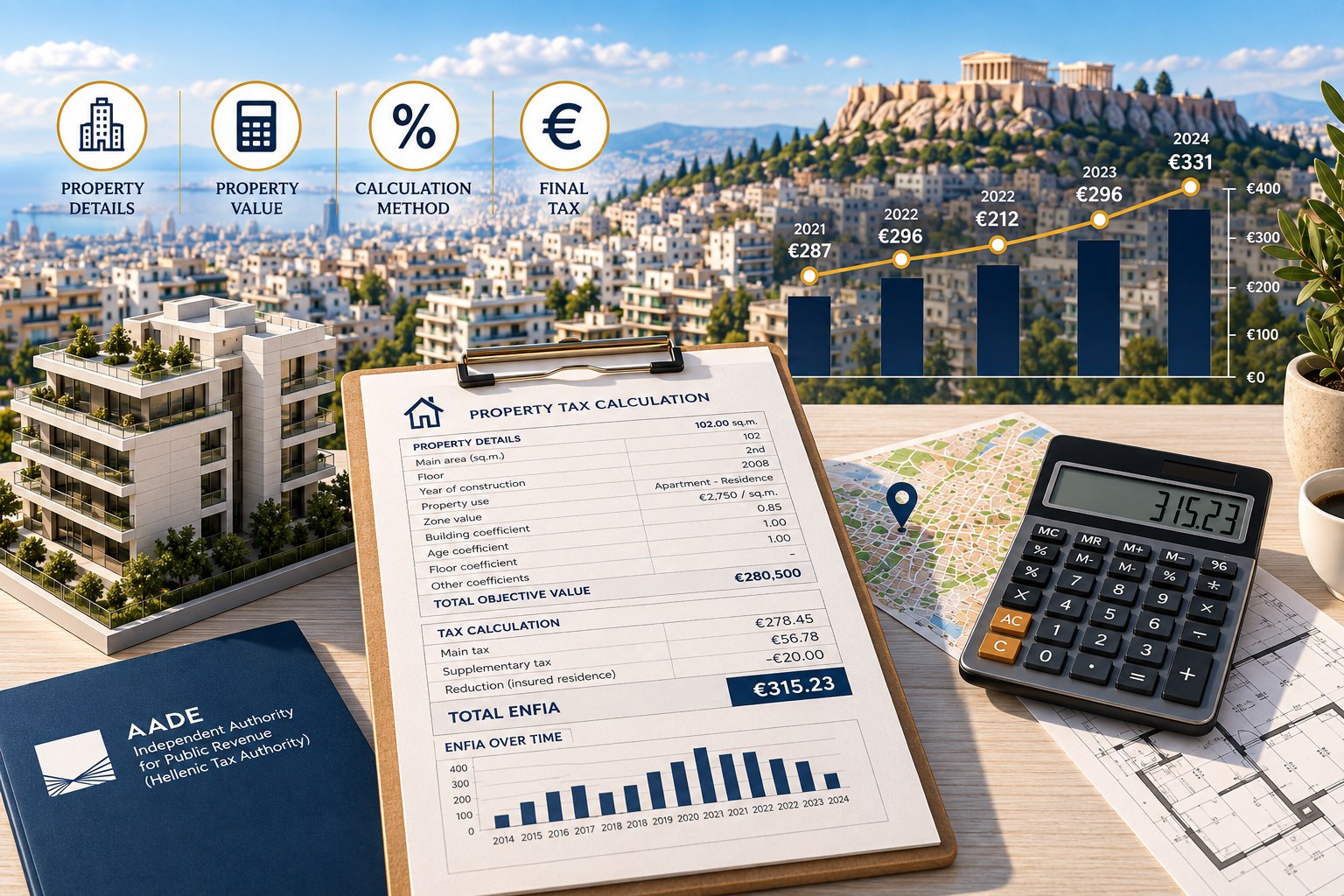
The Unified Real Estate Property Tax (ENFIA) is imposed annually on rights in rem over properties located in Greece. As a general rule, ENFIA for each year is calculated based on the property rights held by the taxpayer on 1 January of that year. Therefore, if a property is purchased during the year, the ENFIA liability for that year generally remains with the person who held the relevant property right on 1 January.
The tax is calculated based on the property information declared to the Independent Authority for Public Revenue (AADE) and is influenced by factors such as:
- The property’s surface area.
- Its location and applicable zone value.
- The age of the property.
- The floor on which it is located.
- The property’s designated use.
- The specific characteristics of the building or land plot.
- The type and percentage of the right in rem held.
For this reason, accurately recording property ownership and characteristics in the E9 Property Declaration is particularly important, as incorrect information may result in an inaccurate ENFIA assessment.
Special tax increases also apply to high-value real estate holdings. Among other provisions, when the total value of real estate owned by an individual exceeds €500,000, an additional tax increase applies according to the prescribed scale. Consequently, owners of substantial real estate holdings should assess their ENFIA obligations based on their entire property portfolio rather than considering each property in isolation.
Are there any ENFIA reductions or exemptions, and what are the eligibility criteria?
Greek legislation provides ENFIA reductions or exemptions for specific categories of taxpayers, provided that the applicable income, property, family, and other statutory requirements are satisfied.
A particularly important provision concerns the ENFIA reduction for insured residential properties. For 2026, where a residence is insured against earthquake, fire, and flood, and all other statutory conditions are met, the following reductions apply:
- 20% for residential properties with a taxable value of up to €500,000.
- 10% for residential properties with a taxable value exceeding €500,000.
Where insurance coverage has been maintained for only part of the year, the reduction may apply proportionally, provided that the minimum required insurance period has been satisfied.
From 2026, a 50% ENFIA reduction is also provided for primary residences located in certain small settlements, subject to specific statutory requirements, including population and property-related criteria.

I rent out my property and receive rental income. How is my rental income taxed?
When an individual earns rental income from property located in Greece, that income is taxed separately as income from immovable property. For income earned from the 2026 tax year onwards, the following progressive tax brackets apply:
- Up to €12,000: 15%
- €12,000.01 – €24,000: 25%
- €24,000.01 – €36,000: 35%
- Over €36,000: 45%
Taxation is progressive. This means that each portion of rental income is taxed at the rate applicable to its respective bracket, rather than applying the highest rate to the entire income.
Where a property is owned by a company, the income generated from its exploitation forms part of the company’s business results and is taxed in accordance with the rules applicable to legal entities.
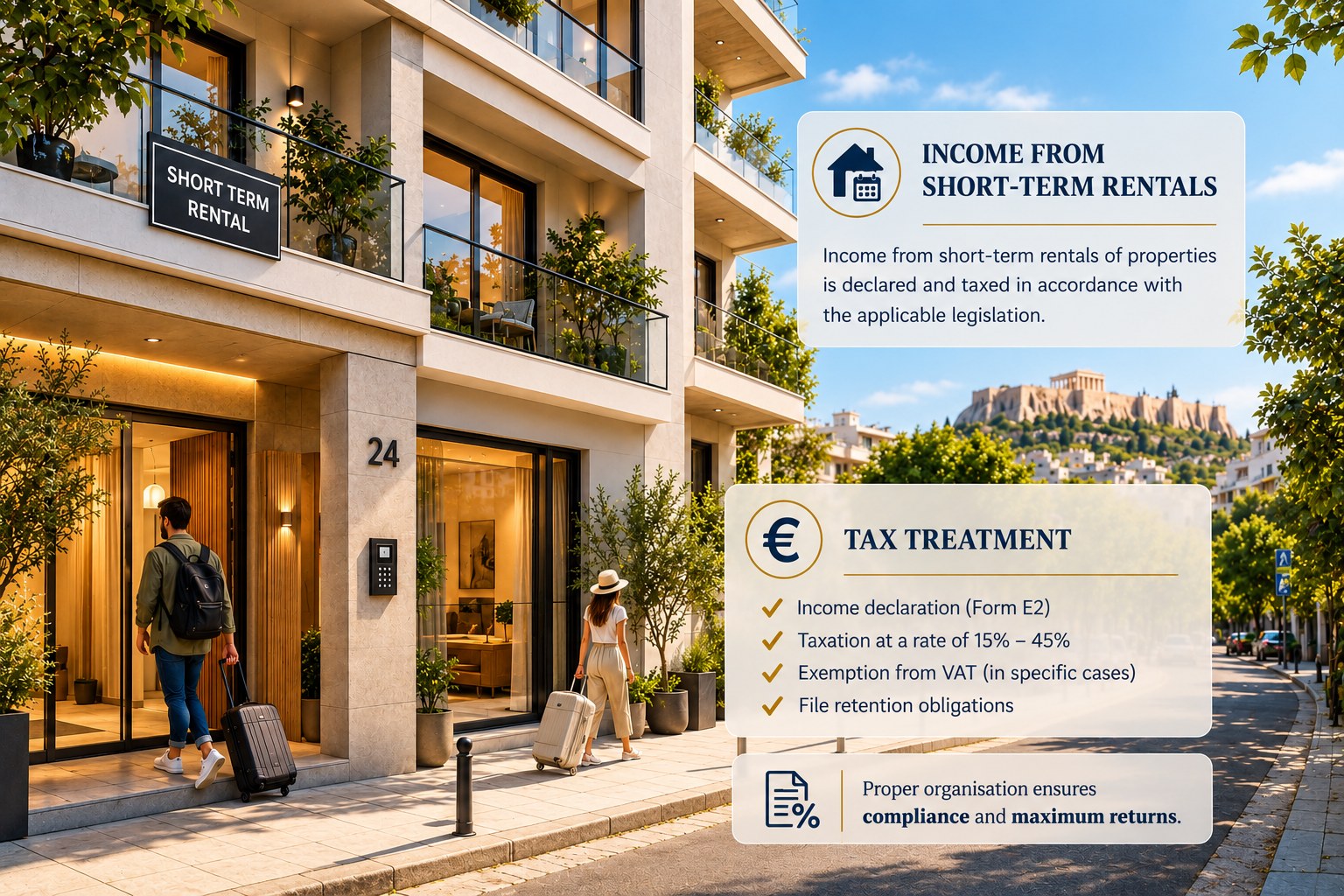
Does the tax treatment change if my property is used for Airbnb or other short-term rentals?
If the property is located in an area where its use for Airbnb or other short-term rental platforms is legally permitted, its exploitation is subject to a specific tax and regulatory framework.
For an individual offering up to two furnished properties for short-term rental, without providing additional services other than bed linen, the resulting income is generally treated as income from immovable property.
Conversely, when an individual offers three or more properties for short-term rental, the income is treated as business income, giving rise to additional tax and administrative obligations.
Providing additional services to guests may also change the tax and legal classification of the activity.
Furthermore, the applicable short-term rental obligations must be fulfilled, including registration with the AADE Short-Term Stay Property Registry, where required, and submission of the relevant declarations.
I inherited a property from a relative. Will I have to pay inheritance tax?
When a property is acquired through inheritance, the applicable tax burden depends primarily on:
- The value of the inherited share.
- The degree of kinship between the heir and the deceased.
Greek legislation classifies heirs into different kinship categories, each subject to different tax-free thresholds and tax rates.
Category A includes, among others, spouses or civil partners, children, grandchildren, and parents. For this category, a general tax-free threshold of €150,000 per heir applies, after which the prescribed progressive tax scale is applied.
In addition, a special exemption of up to €400,000 is provided for acquisitions upon death by a spouse or civil partner and minor children, provided that the specific statutory conditions are satisfied.
The more distant the family relationship, the more the applicable tax treatment may differ, generally resulting in a higher tax burden.
How does a parental transfer or donation of property differ from inheritance?
Parental transfers and donations are subject to different tax treatment from inheritance.
For donations and parental transfers of assets to individuals belonging to Category A, such as transfers from parents to children, a tax-free threshold of €800,000 applies.
As a general rule, any value exceeding €800,000 is subject to a 10% tax on the excess amount.
This provision is particularly significant for family wealth and estate planning, as it may allow substantial assets to be transferred from one generation to the next with limited or no immediate tax liability.
Before proceeding with a transfer, however, it is necessary to examine the value of the assets, the family relationship, any previous donations or parental transfers between the same individuals, and the specific requirements established by tax legislation.
I live abroad. What should I know about the taxation of my property in Greece?
Residing abroad does not exempt a property owner from tax obligations associated with real estate located in Greece.
A non-resident who acquires property in Greece must obtain a Greek Tax Identification Number (AFM) and ensure that the property is correctly declared through the relevant Greek tax administration systems.
If the property generates income, additional obligations arise regarding the declaration and taxation of that income in Greece. Furthermore, the potential application of a Double Taxation Agreement (DTA) between Greece and the owner’s country of tax residence must be examined.
Why is proper legal and tax planning important before completing a property investment?
Property taxation is not limited to the tax paid at the time of purchase. The method of acquiring the property, the identity of the purchaser, the intended use of the property, its exploitation through long-term or short-term rentals, its future sale, and its transfer through donation, parental transfer, or inheritance may all have significant legal and tax implications.
For this reason, proper planning should take place before the investment is made, rather than after it has already been completed.
The lawyer plays an important role in this process by examining the legal structure of the investment, identifying matters that must be addressed before the transaction, and coordinating, where necessary, with the notary, accountant, tax adviser, and other relevant professionals.
This approach enables investors to understand the legal and tax implications of their decisions from the outset and to structure their real estate holdings with a long-term perspective.
Why Choose SF Legal Law Firm?
SF Legal Law Firm provides comprehensive legal assistance to Greek and international property owners and investors in matters relating to real estate in Greece.
Our services cover every stage, from the legal structuring and acquisition of property to its exploitation, sale, donation, parental transfer, and inheritance, working in cooperation with specialised tax advisers and other professionals whenever necessary.
Our objective is to ensure that every investment is carried out with legal certainty, a clear understanding of its tax implications, and appropriate long-term planning.
This article is intended for informational purposes only and is based on the tax framework applicable at the time of publication. The tax treatment of each case depends on the specific factual circumstances and tax position of the individual concerned.