

 By Spanos Theodoros · · Updated
In property leases, the terms “lease agreement” and “electronic lease agreement in Taxis” are often used as though they refer to the same thing.
These are two different things serving different purposes.
On the one hand, there is the agreement between the landlord and the tenant, which may be set out in detail in a private written agreement. On the other hand, there is the Declaration of Information on the Lease of Immovable Property, which is submitted electronically to the Independent Authority for Public Revenue (AADE).
What Is a Private Lease Agreement?

A private written agreement is the document in which the landlord and the tenant can record in detail the terms they have agreed upon for the lease.
In addition to the basic particulars, such as the property, the rent and the duration, it may regulate matters such as:
- the security deposit,
- rent adjustments,
- common charges and other expenses,
- the use of the property,
- subletting,
- repairs and maintenance,
- alterations or works carried out on the property,
- the handover and return of the property,
- as well as other special terms of the particular lease.
The private written agreement therefore enables the parties to maintain a clear and detailed record of their agreement.
What Is the Electronic Declaration to the AADE?
What is commonly referred to in everyday practice as an “electronic lease agreement” or a “lease agreement in Taxis” is, in fact, the Declaration of Information on the Lease of Immovable Property.
This declaration is submitted electronically to the AADE and is made for tax purposes.
The AADE itself clarifies that the declaration is submitted for tax purposes and does not determine the relationship between the landlord and the tenant. That relationship is governed by the applicable civil law and the agreement between the parties.
The electronic declaration requirement applies to both written and oral lease agreements.
Are Both a Private Written Agreement and an AADE Declaration Necessary?

The electronic declaration must be submitted in cases where the tax legislation imposes such an obligation.
However, this does not mean that a detailed private written agreement is unnecessary.
Particularly in long-term leases, recording the agreement in writing is important because it allows the parties to regulate in detail matters that are not reflected to the same extent in the electronic declaration.
In simple terms:
the declaration to the AADE serves to report the lease for tax purposes, whereas the private written agreement records in detail the terms agreed upon by the landlord and the tenant.
Who Submits the Declaration, and When?
Generally, the Declaration of Lease Information is submitted electronically by the landlord.
The initial or amended declaration must be submitted by the end of the month following the commencement or amendment of the lease. When a lease is terminated, its termination must also be declared by the end of the following month.
What Rules Apply to Acceptance by the Tenant?
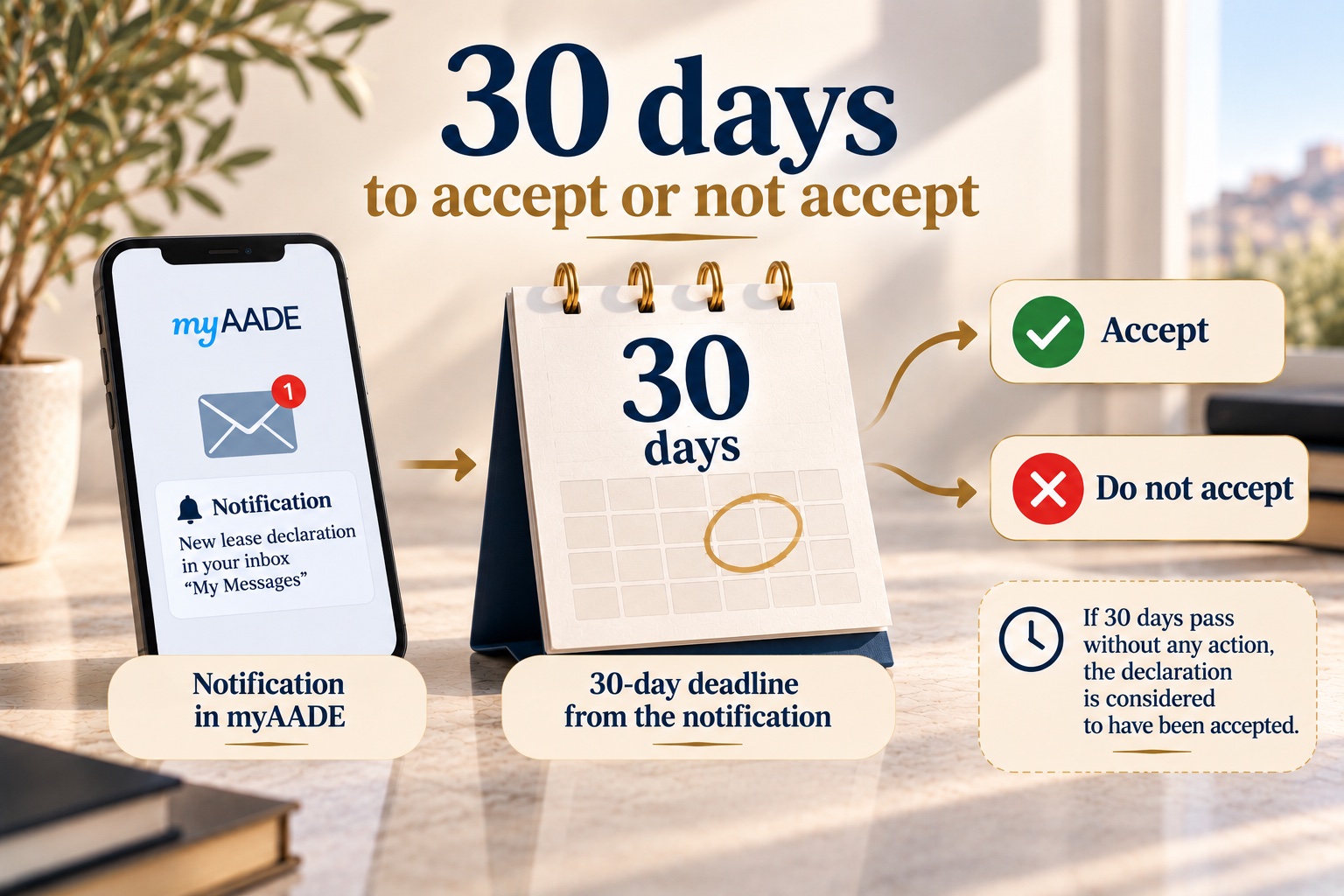
Since 2 June 2025, an important procedure has applied which tenants should be aware of.
After the declaration is submitted, the tenant receives a notification in the “My Messages” inbox on myAADE, as well as an electronic notification at their registered email address.
The tenant then has 30 days from the date the notification is sent to accept or reject the declaration electronically.
If the tenant rejects the declaration, they may state the relevant reasons.
If the 30-day period expires without the tenant taking any action, the declaration is deemed to have been accepted.
This procedure concerns the electronic declaration to the AADE and does not turn that declaration into a substitute for a detailed private written agreement.
What Happens if the Private Agreement and the AADE Declaration Do Not Match?

If the private written agreement and the electronic declaration contain different particulars, for example a different rent or lease duration, the discrepancy should not be ignored.
It would be incorrect to assume automatically that one document always “prevails” over the other. It is necessary to examine what the parties agreed, what particulars were declared to the AADE, and why the discrepancy arose. For this reason, before accepting the declaration electronically, the tenant should verify that the declared particulars correspond to the agreement they entered into.
Likewise, the landlord should ensure that the particulars submitted to the AADE are accurate and consistent with the corresponding terms of the lease.
Conclusion
The private written agreement and the electronic declaration to the AADE do not constitute two separate leases. They concern the same lease relationship but serve different purposes.
The Declaration of Lease Information fulfils the relevant tax obligation and records specific particulars of the lease.
The private written agreement, by contrast, allows for a detailed record of the rights, obligations and specific arrangements agreed between the parties.
For this reason, particularly in long-term leases, a properly drafted private written agreement, together with the correct electronic declaration of the lease, provides a clearer framework for both landlord and tenant.